Protolabs said on November 3, 2026 that it had increased its HP Jet Fusion 5600 series capacity by 50%, citing demand from drone and aerospace customers. That is a manufacturing-capacity announcement. A buyer still needs a quote for the particular design, quantity and required inspection before changing a project schedule.
Protolabs’ November 3 company announcement
Separate the factory headline from the order
The company’s release describes expanded Multi Jet Fusion printing capacity for prototypes and production parts. It does not establish that every customer’s finished-part delivery time falls by the same percentage. Protolabs’ design guidance recommends comparing the quoted lead time and price for the submitted CAD file.
Protolabs’ MJF design and quoting guidance
Inspection can also have its own requirements. Protolabs’ quality page distinguishes an informational Reference Report from a pass/fail Dimensional Inspection Report. It lists additional time for reporting and says extra dimensional evaluation can increase both lead time and price. Ask which report your order needs and how it is included in the quote.
Protolabs’ inspection and reporting options
Try a fictional two-stage capacity calculation
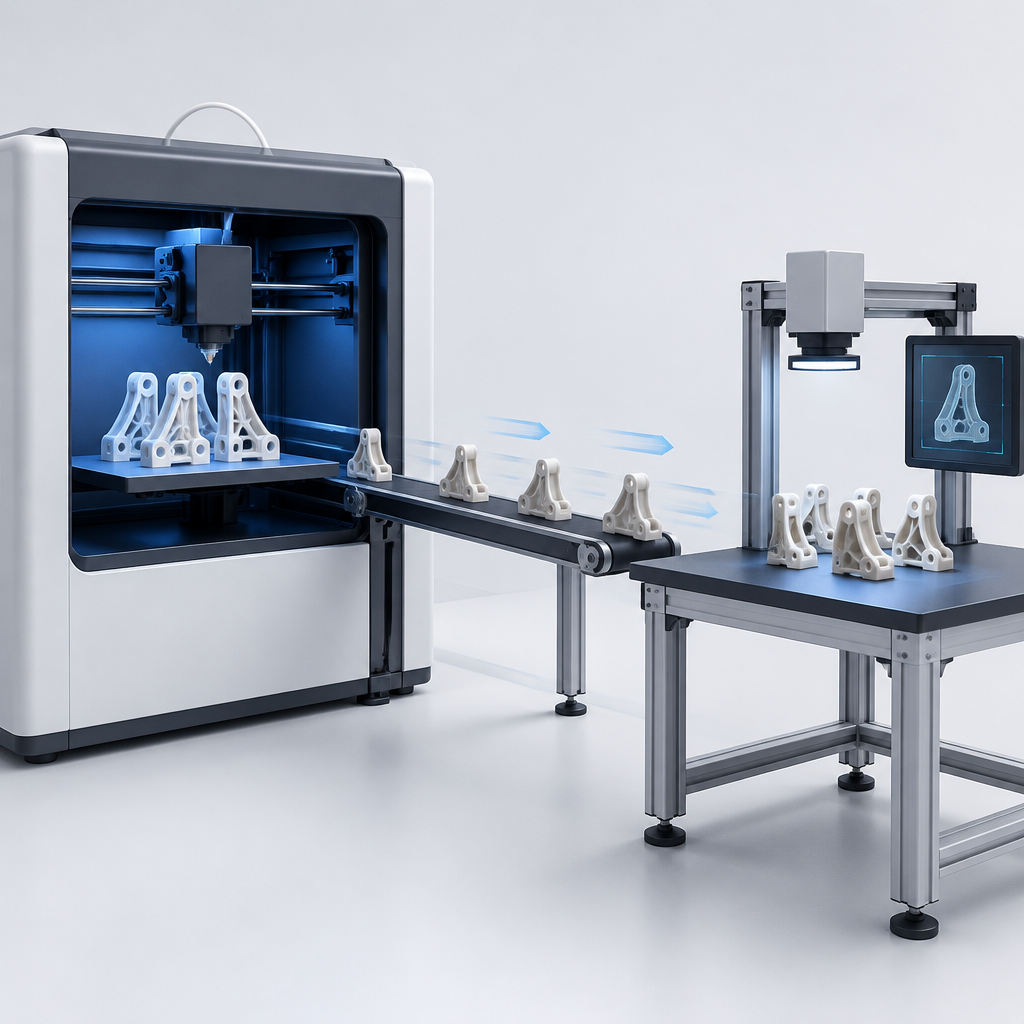
Imagine a simplified training factory making identical demonstration parts. Its printing stage can supply 100 parts per day, while its final inspection stage can release 80 per day. Assume steady operation, no rejects, sufficient material and enough work waiting. These are invented teaching numbers, not Protolabs operating data.
Increase only printing capacity by 50%. The new printing figure is 100 × 1.5 = 150 parts per day. Inspection still releases 80. Under these assumptions, the finished output remains limited to 80 per day; the faster printing stage can instead create a larger queue awaiting inspection. This arithmetic explains a possible bottleneck, not a finding about the supplier’s factory.
Now change the fictional inspection limit to 180 parts per day. Printing becomes the limiting stage at 150. The same printing expansion has a different effect because the other stage changed. Neither example calculates a real delivery date: order size, work already queued and the starting stock between stages are not specified.
Make a quote comparison answer the same question
For an actual sourcing review, keep the design revision, quantity, material, finish and required report together. If you compare two offers, mark any difference in those requirements before comparing their timing. A quote for an unfinished prototype and one for an inspected production batch describe different deliverables.
Ask when the quoted timing starts, which operations it includes and when the specified deliverable is expected to ship. Keep transport and your own receiving checks visible in the project plan. If you change the drawing or inspection requirement, obtain a corresponding timing update rather than carrying forward an earlier estimate.
The expansion is useful supplier news, while the quote remains the evidence for a specific order. No quote, factory queue, inspection result or delivery performance was independently tested for this article. The fictional calculation should not be used to infer the supplier’s utilization, actual bottlenecks or customer outcomes.