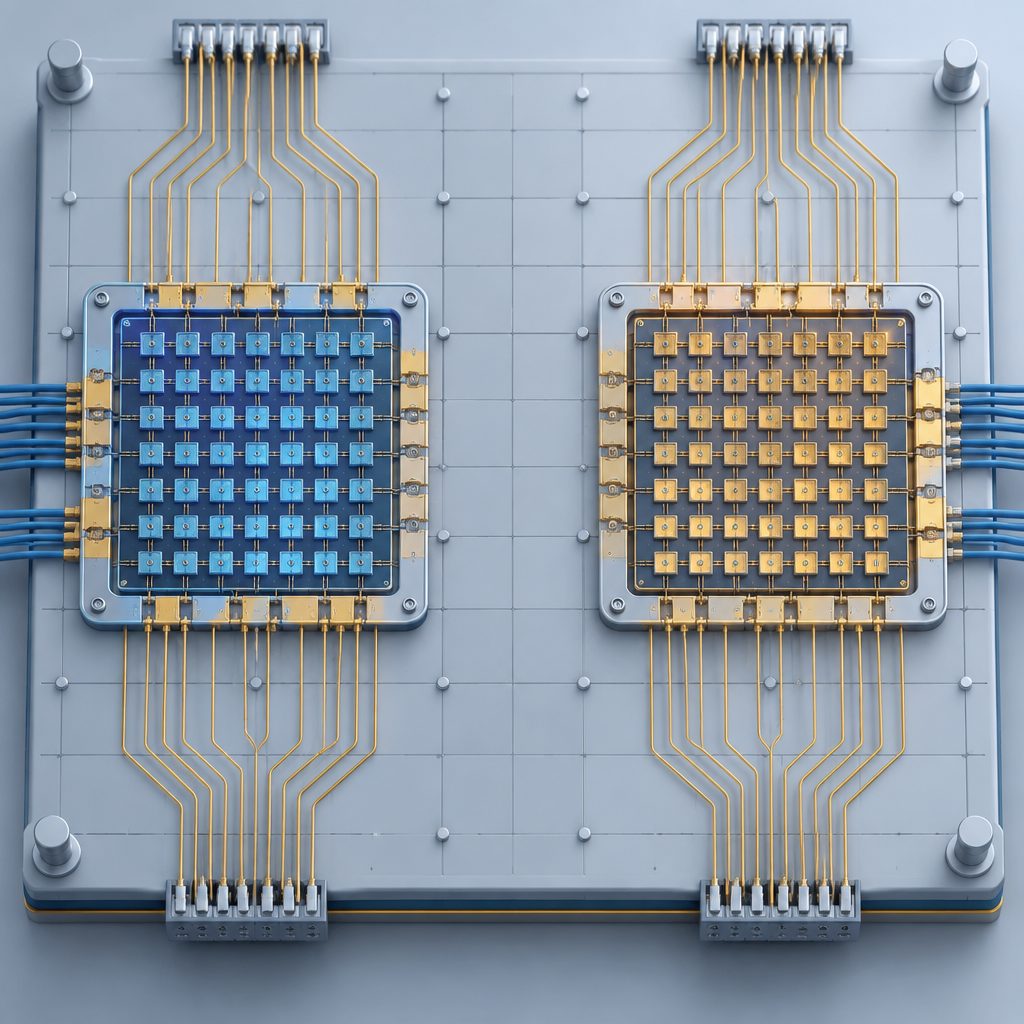
IBM’s November 11, 2026 announcement frames Nighthawk r3 as a step toward larger, more capable quantum systems, but the useful question for researchers and technical readers is narrower: which claims can be measured now, and which are still design targets? That distinction matters because benchmark language can blur together current hardware results, simulator studies, and future system plans. For practical testing, the safest approach is to separate what IBM reports for today’s r2 hardware from what IBM says r3 is designed to deliver.
Here is the cleanest way to read the numbers. IBM reports that Nighthawk r2 has 120 programmable qubits, supports accurate circuits with more than 7,500 quantum operations using probabilistic error amplification, and reaches up to 100,000 samples per second. Those are reported figures, and they should be treated as distinct measurements or performance claims, not as one combined end-to-end workflow promise. A sample, in this context, means one measurement result from a repeated circuit execution.
For r3, IBM says the system is designed for 10,000 quantum operations on 520 programmable qubits. IBM also plans to connect two r3 chips into a 1,040-qubit system in 2027. That second statement is a roadmap target, not a demonstrated availability claim, and it should not be read as proof of any particular gate count, quantum advantage for a test problem, or logical or fault-tolerant qubit capability.
What you can test now on hardware
Start with a small circuit and a reference result you can check. Record the backend, the transpiled gate count, the number of layers of two-qubit gates and the shot count. If you can measure queue time, device execution time and classical processing separately, record each one.
For an illustrative pilot, apply a Hadamard gate to the first qubit and use it to control a NOT gate on the second. In an ideal simulator, measurements in the computational basis yield 00 or 11 with equal probability; 01 and 10 have zero probability. On hardware, keep the circuit and shot budget fixed and compare the fraction of outcomes with matching bits. This checks one aspect of the output; matching bits alone cannot verify entanglement.
This pilot should be reported carefully. If the hardware result deviates from the reference, that is still useful data. The point is not to prove superiority; it is to measure stability, error sensitivity, and the effect of compilation choices. If the platform reports queue time separately from execution time, and classical postprocessing separately again, keep those values apart. Mixing them into one headline metric makes the experiment harder to interpret.
What r2 numbers mean in practice
The r2 figures are most useful as a baseline for planning. More than 7,500 quantum operations with probabilistic error amplification tells you that IBM is already publishing results in a regime where circuit quality is being extended by mitigation methods rather than by idealized hardware alone. That matters for experiment design: if your goal is to understand whether a circuit pattern is hardware-feasible, you should test the circuit both with and without mitigation where the software stack allows it, then document the difference in the measured observable and in the resource overhead.
The reported up to 100,000 samples per second is also a useful benchmark, but it should be interpreted narrowly. It is a throughput figure, not a guarantee of how fast your full workflow will finish. It does not automatically include queue delay, compilation, calibration drift, or your own analysis code. If you are comparing backends, compare samples per second only when the circuit, shot budget, and measurement settings are held constant.
What r3 targets can and cannot support yet
IBM’s target of 10,000 operations on 520 programmable qubits is a starting point for a future benchmark. When r3 becomes available, use the same small circuit as a baseline. Then compare a family of circuits at increasing depths on both processors, using a fixed shot budget and the same error tolerance against a known reference.
The planned two-chip 1,040-qubit system for 2027 should be treated even more cautiously. A larger qubit count does not by itself justify claims about algorithmic advantage, fault tolerance, or useful problem size. For now, the right interpretation is only that IBM plans a connected system with more programmable qubits. Any future benchmark on such a system would still need a defined circuit, a fixed shot budget, and a reference observable before it could say anything meaningful.
Simulator first, hardware second
A simulator is useful for three tasks: validating the reference observable, estimating ideal output distributions, and checking how compilation changes the circuit before you consume hardware time. Hardware is where you test noise, mitigation, queueing, and runtime behavior. If you are writing up the result, say clearly which parts were run on simulator and which on hardware. That is especially important when the hardware result is close to the simulator result, because the difference may reflect mitigation, not raw fidelity.
Backend access still depends on plan and availability. That is not a minor caveat; it is part of the experiment design. A practical benchmark should be reproducible enough that another user with comparable access can rerun the same circuit, with the same shot budget, on the same class of backend and compare the same observable.
Bottom line
If you want to test IBM’s Nighthawk story today, focus on the measurable pieces: r2 hardware performance, circuit depth after transpilation, sample throughput as reported, and the gap between hardware results and a known reference. Treat r3’s 10,000-operation, 520-qubit design target as a future benchmark line, not a current proof. And treat the two-chip 1,040-qubit plan for 2027 as a roadmap item, not a demonstrated system. That discipline keeps the conversation grounded in what can actually be measured now.
IBM newsroom announcement, November 11, 2026
IBM Quantum blog: dev tools QDC 2026