Three projects at three different stages
When New York State announced nearly $13 million across 15 storage projects on Nov. 6, the headline number was easy to remember. The harder part is understanding what each award is meant to prove. In energy storage, a grant amount is not the same thing as installed capacity, and a project description is not the same thing as a finished commercial system. The most useful reading is to separate three things: the size of the test, the measured output at stated conditions, and the status of the site where the work will happen.
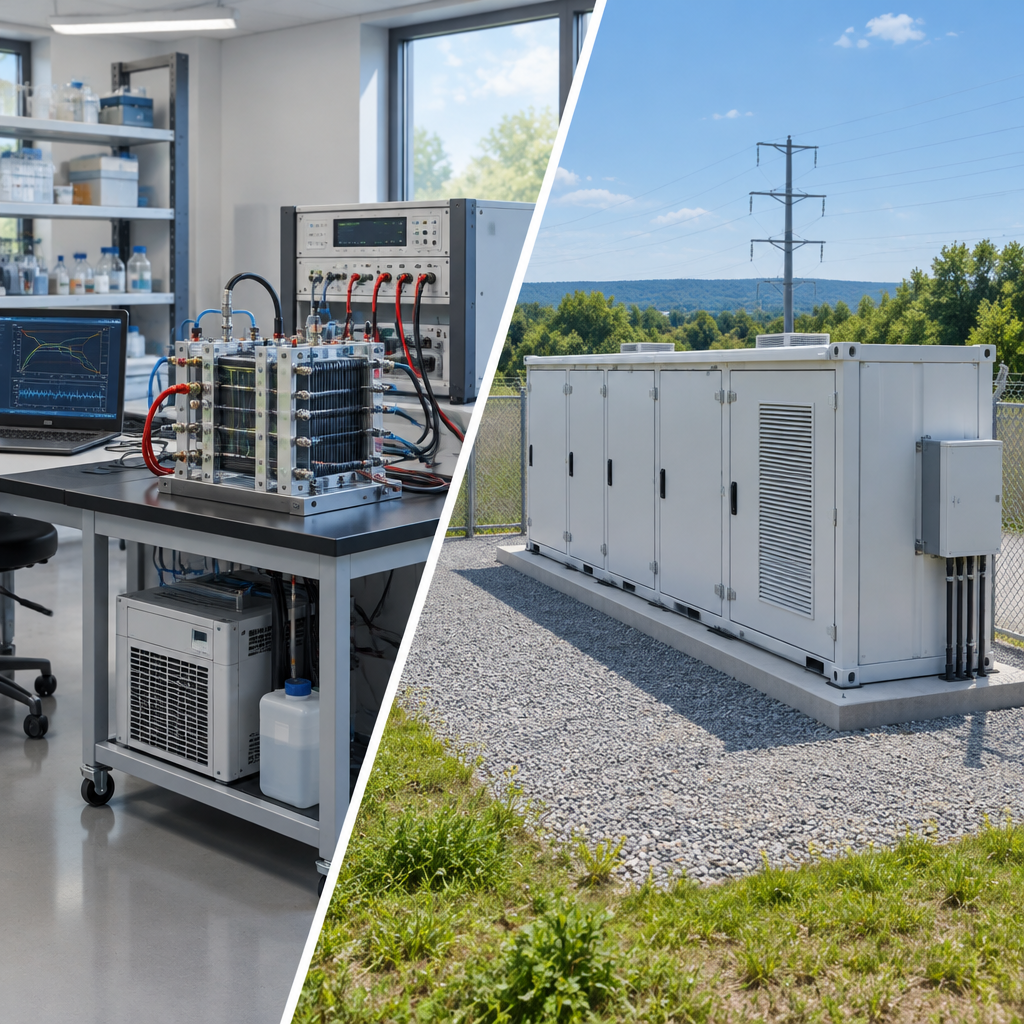
Aestus: a subscale heat-sink test, not a 20 MWh system online
Aestus received a little over $590,000 for a roughly 35 kWh subscale ceramic heat-sink test. That figure matters because it describes the experiment size, not a full project already delivering grid-scale storage. The test is intended to inform the design of a 20 MWh advanced compressed-air system, but the award itself does not mean a 20 MWh installation is operating now. At this stage, the core question is whether the subscale hardware can validate the thermal and engineering assumptions needed for a much larger system later.
Alsym: a 10 kWh prototype with a research partner
Alsym was awarded more than $290,000 to design and test a 10 kWh sodium-ion prototype with the RIT Battery Development Center. Here too, the number is best read as a development scale, not as a commercial deployment claim. A 10 kWh prototype can help answer questions about cell behavior, safety, integration, and repeatability, but it is still a prototype. The award description points to engineering validation work, not a finished product in the field.
Inlyte: a deployment focused on duration, not a stated measured runtime
Inlyte received more than $2.4 million to deploy an iron-sodium battery designed for more than 10 hours of storage. That wording is important. It describes the intended design duration, not a measured runtime already demonstrated under one fixed condition. It also does not tell readers the system’s power rating or energy rating in this announcement. So it is safer to say the project targets long-duration operation than to assume any specific MW or MWh figure that was not stated in the award summary.
What to look for next
- Test size: Is the project a lab-scale prototype, a subscale system, or a field deployment?
- Measured output: What did the system actually produce or sustain at stated conditions?
- Test site status: Is the work in a lab, pilot site, or live utility-connected setting?
- Duration language: Does the announcement say a battery is designed for a certain number of hours, or that it has already achieved that runtime in testing?
That distinction helps keep storage coverage accurate. A funding award can be an important signal of technical progress, but it should not be read as guaranteed performance, installed capacity, or a promise that every project will land at the same duration target. The most informative updates will come when these projects report test results, operating conditions, and where the hardware is actually being evaluated.