Farol’s PR Risk Score: Verify the Evidence Before You Merge
A pull request can change very few lines and still affect a busy part of an application. Farol, an open-source command-line tool and GitHub Action from Winnin, maps changed code to the pages and operations that depend on it. Its practical promise is helping a reviewer decide where to spend attention.
The project documents TypeScript/React, Go and Python support, subject to framework and analysis limits. It is MIT-licensed. Its report advises a human reviewer; it does not approve a merge or make an application correct. Treat the risk number as a starting point for investigation.
Farol overview, supported stacks and limitations
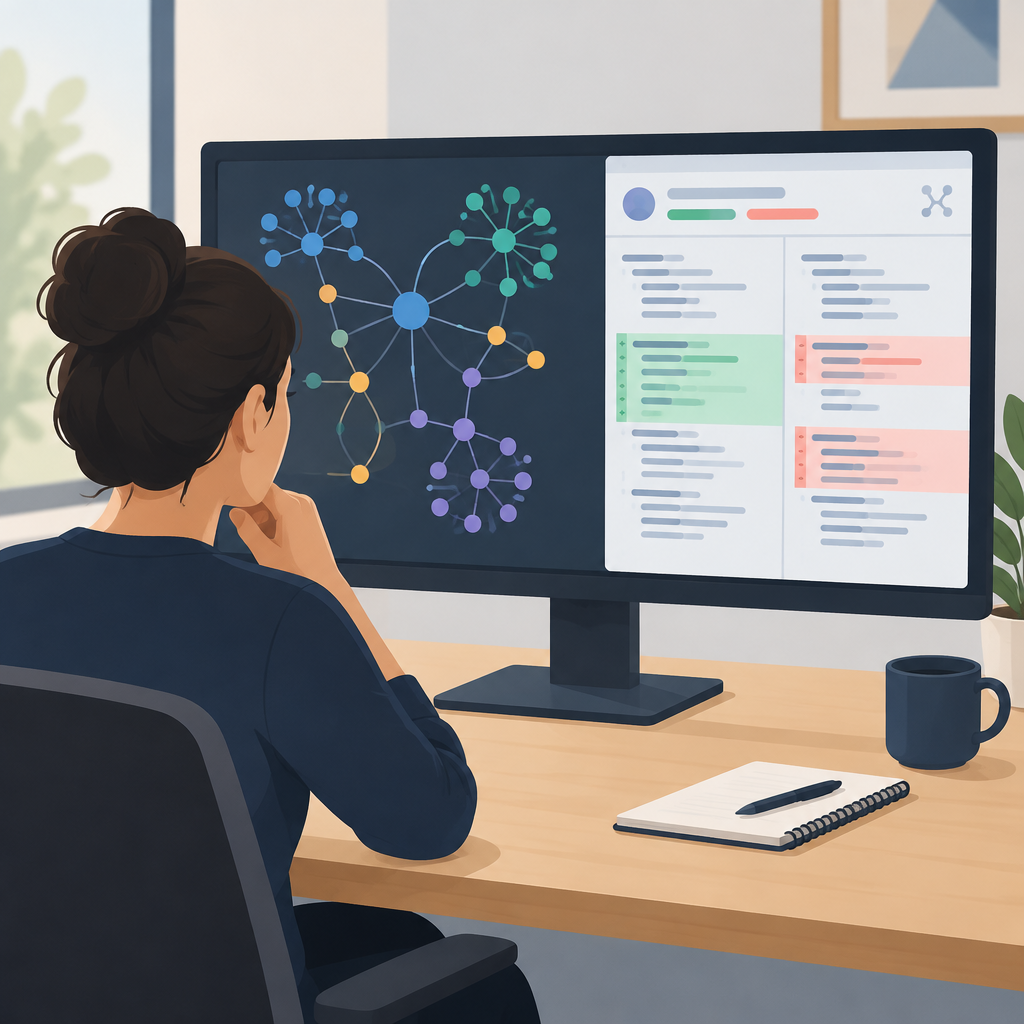
Conceptual illustration; this is not a screenshot of Farol.
Establish what the tool can see
The setup guide starts with a project configuration describing language, entry points and file roles. Coverage, lint and vulnerability reports come from your existing tools: Farol reads those outputs rather than running the tools itself. An absent report is marked not verified. It is not evidence that a check passed.
Before interpreting a result, compare the entry points reported by Farol with the application you know. The examples guide suggests routes for listing them and impact for following a file’s reach. If a page is missing, inspect supported route forms and dynamic-route diagnostics. Also verify report paths: command-line paths are relative to the working directory, while configuration paths are relative to the project.
Configuration recipes and setup troubleshooting
Make the comparison reproducible
The reference requires Node.js 22 or later, git and the full history of both compared branches. CI examples use fetch-depth: 0. Go projects need Go and cached module dependencies; Python projects need python3 3.11 or later. Record your tool version, configuration and compared commit IDs when evaluating a report.
The reference distinguishes fast track, quick review and careful review. An unreadable part of a change can trigger careful review, as can a breaking contract change or serious finding. The score also changes as files are marked reviewed. Keep a record of the initial result as well as the completed review; the remaining score describes the workflow’s state.
Requirements, verdict rules and score calibration
A score is a model, not an observed failure rate
Farol’s methodology combines weighted items into a 0–100 score using an independence assumption. Coverage reduces the contribution of changed code without eliminating it. That calculation is not a measurement that this particular deployment has a matching percentage chance of failing.
The pipeline reads code and follows relationships to entry points. It uses declaration-level or module-level analysis depending on language and file circumstances. Dynamic behavior can escape static analysis; the overview explicitly lists runtime-built values and unsupported router patterns as limitations. Investigate unknown results rather than translating them into a clean bill of health.
Analysis pipeline, signal handling and score formula
Keep execution and reporting permissions separate
The security policy says analysis does not execute the repository’s code. Its example workflows separate the job running pull-request code, with no secrets and a read-only token, from the job posting comments. The HTML report loads an external Mermaid script when a route graph is opened. Local analysis, report viewing and API-backed commands have different boundaries; inspect the workflow you actually adopt.
Project security model and report-rendering boundaries
Try a small retrospective first
A useful pilot is to examine several already-reviewed changes, including one that caused a regression. Compare identified entry points, missing inputs and suggested review priorities with what actually happened. Record omissions before using the report to allocate review time. These are proposed evaluation steps; no installation, benchmark or repository trial was performed for this article.
Read the report before approving
Use the map to focus attention, then preserve the evidence behind the decision: what the tool saw, which inputs were missing, what a person inspected and what tests actually ran. That record is more useful to the next reviewer than a number on its own.