Dotwork’s Enterprise Operating Model: Test One Shared-Team Trade-Off
Dotwork announced its Enterprise Operating Model on Nov. 9, 2026. The company says the model connects portfolio planning with delivery and other records. Buyers can test that idea with a familiar problem: two projects need the same team in the same week.
Dotwork solution page: Strategic Portfolio Management
What the vendor is describing
In practical terms, Dotwork is describing a connected planning approach for governance and delivery decisions across the portfolio. For a buyer, the useful question is not whether the platform sounds comprehensive, but whether a shared operating model helps decision-makers compare demand, capacity, dependencies, and timing using the same assumptions.
That distinction matters. A vendor may offer portfolio planning capabilities, but a buyer still needs a clear worksheet for testing whether the model reflects reality. The evaluation should focus on whether one shared view can support a decision without mixing incompatible data, unclear ownership, or stale assumptions.
A simple trade-off test with one shared team
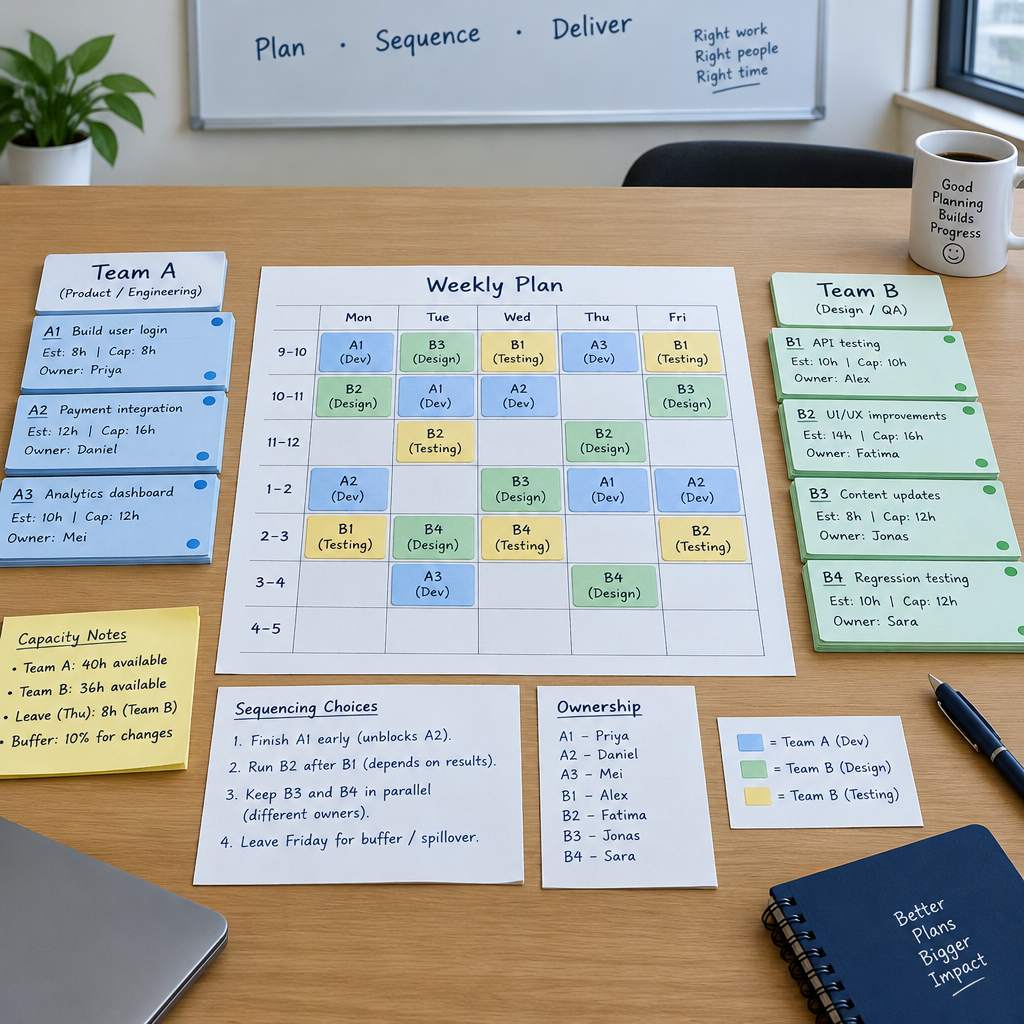
Use a plain example. A platform team has 10 engineer-days available during a single week. Two pieces of work are competing for that capacity: onboarding work needs 6 engineer-days, and reporting work needs 7 engineer-days. If both must finish in the same week, the shortfall is 3 engineer-days.
Now compare sequencing options rather than assuming both can begin at once.
- Option 1: Do onboarding first. Remaining capacity after onboarding is 4 engineer-days, so reporting cannot finish in the same week if it still needs 7 engineer-days.
- Option 2: Do reporting first. Remaining capacity after reporting is 3 engineer-days, so onboarding cannot finish in the same week if it still needs 6 engineer-days.
This is a basic trade-off test, but it is useful because it forces a choice. The right sequence depends on deadline and dependency. If onboarding is needed before reporting can start, onboarding takes priority. If reporting is tied to a fixed deadline and does not depend on onboarding, reporting may take priority. The point is not to optimize around partial work; the point is to compare outcomes under the same capacity rule.
Define the evidence owner before you compare results
Every portfolio comparison needs an evidence owner. The evidence owner is the person responsible for confirming that the inputs are current, complete, and aligned to the same measurement rules. In this example, the evidence owner should confirm the week’s capacity, the estimated engineer-days, the deadline assumptions, and any dependency notes before the comparison is used for decision-making.
If a record is stale, flag it immediately. A stale record could mean the capacity changed, the estimates were updated, or the dependency order is no longer correct. Once stale records exist, the comparison is no longer a reliable basis for action until the discrepancy is resolved.
A practical acceptance test for the planning result
Before relying on the result, use a simple acceptance test:
- The comparison uses the same snapshot for all options.
- Capacity is measured in the same unit across all work items.
- There is one clear evidence owner for the inputs.
- Any discrepancy between records is resolved before the result is used.
If these conditions are not met, the output may still be informative, but it should not be treated as a decision-ready portfolio view. That is true whether the planning is done in Dotwork or in any other enterprise portfolio tool.
Why this matters for enterprise portfolio planning
Enterprise portfolio planning works best when leaders can test one shared-team trade-off at a time. The value is in making the decision logic visible: what is being funded, what capacity exists, what depends on what, and which work must wait. Dotwork’s announcement points to that kind of operating model, but buyers still need to validate it against their own evidence, timing, and ownership rules.
For a practical evaluation, keep the question simple: does the platform help the enterprise use one shared model, one current snapshot, and one accountable owner to decide between competing work? If the answer is yes, the tool may support better portfolio conversations. If not, the planning process may still be fragmented even if the interface looks complete.