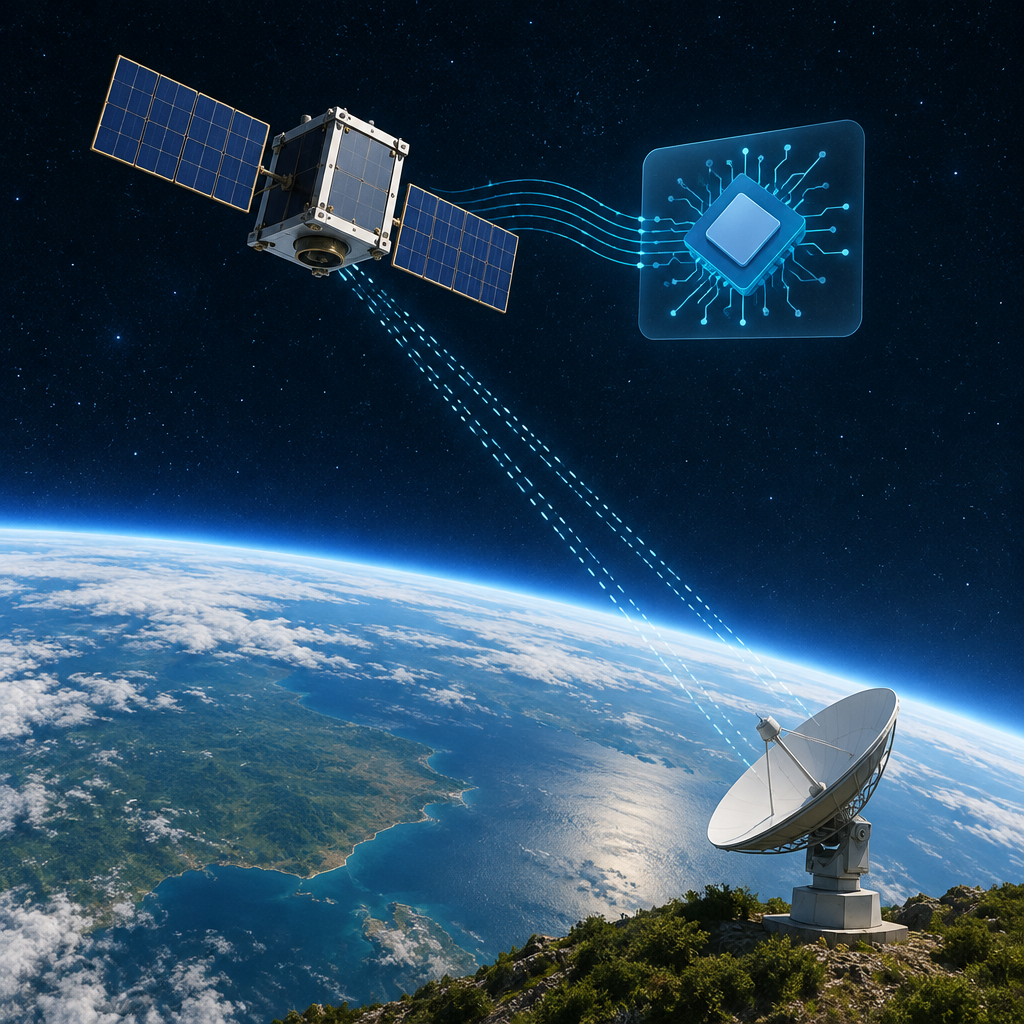
Google reported on October 30, 2026 that its Project Suncatcher prototype had returned an AI-generated response from a data-center-class Tensor Processing Unit, or TPU, in orbit. The company describes the result as a research milestone. The useful question is which part of the proposed system has now been demonstrated.
Google’s October 30 account of the first response
Follow the demonstrated request
Google says it sent a prompt to an onboard Gemma 4 model during a ground-station pass and received a poem as the satellite passed Svalbard, Norway. It also reports follow-up prompts involving other verse and payload telemetry. This is the company’s account of the experiment, rather than an independently reproduced benchmark.
The practical distinction is between evidence that a workload executed and evidence about how a system performs repeatedly under specified conditions. A successful returned response is meaningful, but evaluating reliability also requires a defined workload, observation period and record of unsuccessful attempts.
Keep launch and computation as separate milestones
The prototype launched October 1 with Planet aboard SpaceX’s Transporter-18 mission. Google’s launch announcement reported contact with the satellite. The October 30 response update adds a later stage: reported execution of an AI workload after commissioning activities.
Google’s October 1 prototype launch announcement
When building a timeline, give launch, initial contact, payload operation and returned output their own dated entries. That makes progress visible without silently treating every stage as the same achievement.
Read the remaining engineering questions
Google’s earlier technical explainer identifies cooling, radiation and satellite interconnectivity as research challenges. It describes heat pipes and radiators under investigation and plans to test communication between two satellites in 2027. The October 30 update says further in-orbit thermal-stress and radiation tests are next.
Google’s explanation of the mission’s engineering questions
For a research summary, keep separate columns for observed results and planned tests. A future interconnection experiment belongs in the planned column until a subsequent report supplies its outcome. Preserve the announcement date so readers can tell whether a later result changes the assessment.
Try a fictional evidence exercise
Imagine a separate, invented hardware project returning one correct answer during a ten-minute demonstration. That observation can support the claim that the demonstrated request completed. It supplies no measured failure rate over a month unless the project also publishes the relevant month-long test record.
For that fictional project, ask for total attempted requests, completion criteria, operating conditions, elapsed test time and any recovery actions. These are proposed evidence questions, not missing-data findings about Suncatcher. The example illustrates why different claims need different measurements.
Apply the same discipline when sharing the orbital milestone: identify the reported experiment, credit its source and retain the future tests as future tests. Assessing commercial capacity, service availability or cost would require separate evidence suited to those questions. No satellite hardware, telemetry stream or inference service was independently tested for this article.
Read the milestone accurately