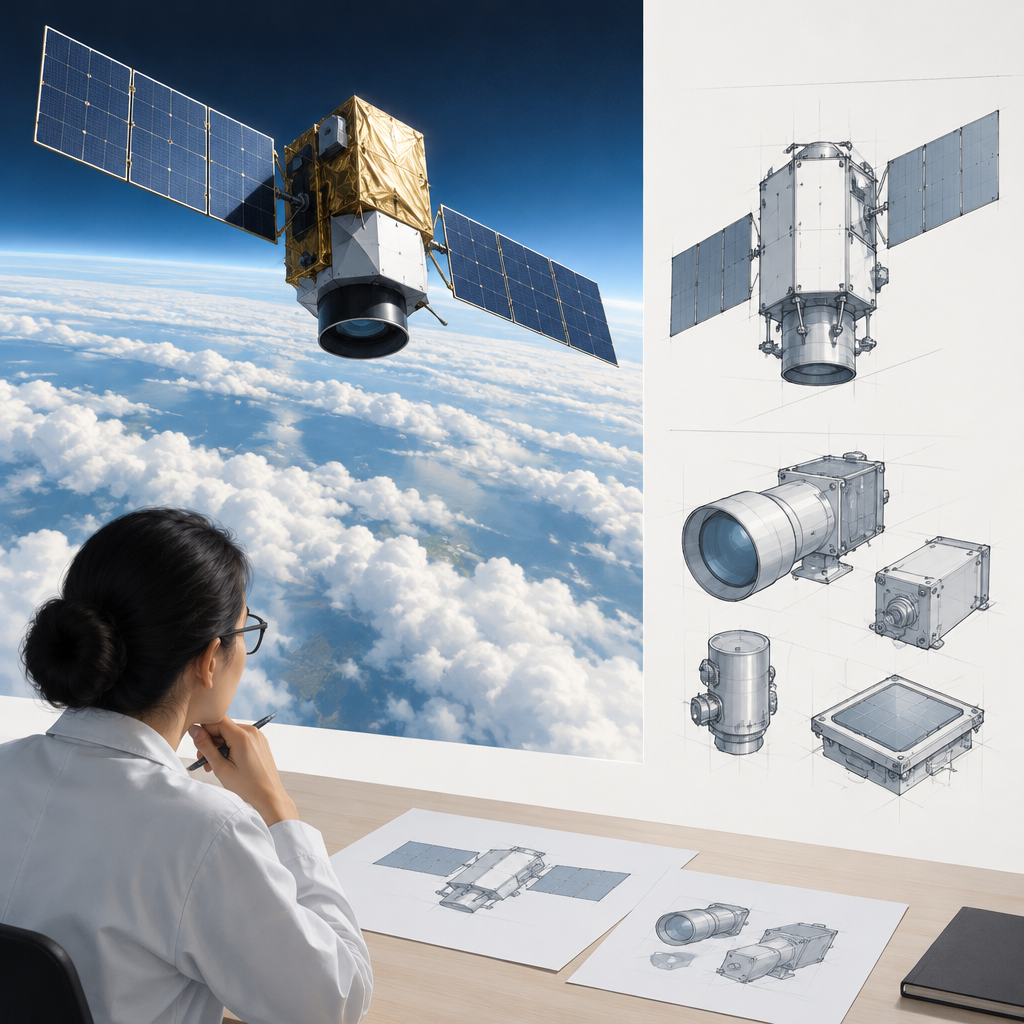
Intuitive Machines announced on November 3, 2026 that NASA’s Jet Propulsion Laboratory selected it to supply the spacecraft platform and system-level integration for FALCON-RADAR. Its release names the IM 300 bus and targets launch no earlier than 2029. This is a useful moment to distinguish the vehicle supporting a science mission from the measurements and products researchers eventually use.
Intuitive Machines’ November 3 announcement
What the announcement describes
The company describes one satellite in a polar, sun-synchronous orbit, carrying a W-band cloud-profiling Doppler radar intended to study light precipitation and small-scale cloud behavior. It says measurements will complement other missions’ observations of water vapor and aerosols. Those are planned scientific roles; the selection announcement does not demonstrate that an operational data service exists.
NASA’s June 5 INCUS update gives broader fleet context: INCUS is also part of FALCON, a collection of atmosphere-observing satellites combining contributions from NASA, universities and commercial partners. That older update concerns INCUS. Its spacecraft details and schedule should not be transferred to FALCON-RADAR.
NASA’s June 5 INCUS update and FALCON fleet context
Use three questions when reading a mission announcement
First ask which organization is supplying which part. In general spacecraft terminology, a bus is the supporting platform, while an instrument performs the scientific sensing task. For this announcement, record the platform and integration role exactly as stated. Do not infer that the platform supplier also owns every instrument, produces every scientific result or controls access to every future dataset.
Next ask what measurement is proposed. Keep the instrument’s intended observation separate from a downstream application. A plan to observe clouds does not, by itself, specify the update frequency, geographic coverage or uncertainty of a future product that a particular research project would need.
Finally ask what evidence would support using that product. Look for the eventual product description, processing version, quality flags, acquisition times and access terms. These are proposed research-planning questions, not statements that the mission has already published those materials or that any particular access policy applies.
Try an original research-planning exercise
Imagine a fictional team comparing cloud observations over a coastal region during two afternoon periods. Its worksheet has separate spaces for the intended measurement, required observation times and the actual dataset to be analyzed. Leave the dataset space unfilled until the team can identify an available product and its documentation. A named future spacecraft cannot fill that space on its own.
If the team later finds a sample, check whether it covers the chosen region and periods, how missing observations are represented and which processing version produced it. Describe the result as a sample evaluation until the relevant coverage and quality questions are resolved. This exercise uses no real mission dataset and supplies no forecast-performance claim.
The current selection matters as a statement of planned spacecraft work. For research planning, retain its qualified launch wording and keep responsibilities, intended measurements and evidence of usable data distinct. No spacecraft, instrument performance, data access or scientific product was independently tested for this article.