Elo announced its Pay M61 mobile point-of-sale computer on November 5, 2026. For a store planning a handheld checkout rollout, the practical buying question is specific: does the quoted model include the barcode scanner, and is its protective boot the matching version?
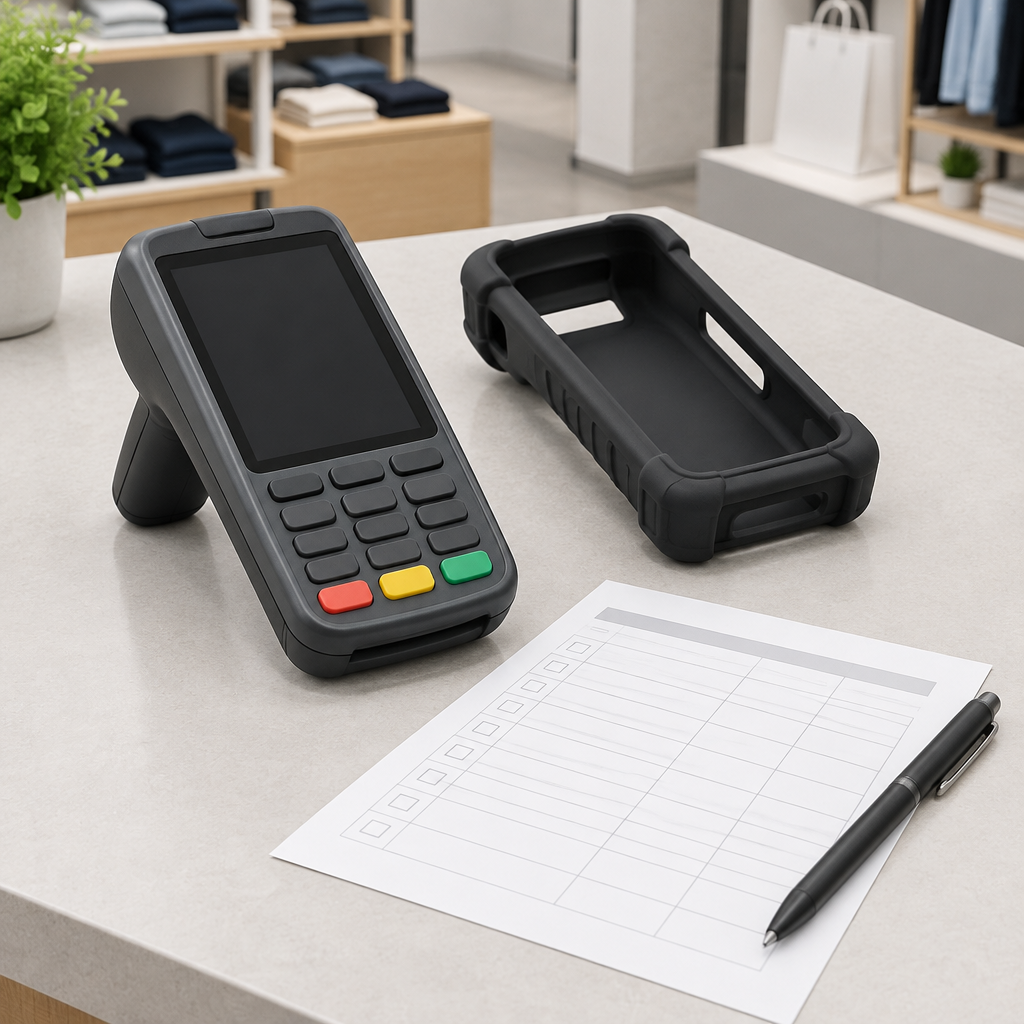
Read the configuration row
Elo’s official PLB 00-262 bulletin describes the scanner as optional and lists separate regional and connectivity configurations. Its USA cellular model E664886 explicitly includes a barcode scanner; E665260 is the listed Wi-Fi scanner model. The shared M61 name does not identify the complete configuration.
The accessory list makes the second distinction explicit: E552091 is the rubber boot for scanner models, while E665863 is for non-scanner models only. Keep that restriction beside the part number when preparing the order.
Write the requirement before comparing offers
Start with the store’s intended workflow. Does the employee need to read product barcodes using the integrated scanner? Will the device operate only on the store network, or does the proposed deployment require cellular connectivity? Record those answers before comparing the supplier’s item codes.
- Terminal: retain the full part number, connectivity region and scanner requirement.
- Protection: retain the boot code and the scanner/non-scanner restriction.
- Commercial offer: obtain the actual quantity, price, stock and delivery commitment.
- Integration: ask the provider to confirm the payment and store-software configuration separately.
For a fictional store worksheet, suppose the requirement is a USA cellular scanner model with a protective boot. A quote naming E664886 and E665863 contains an accessory mismatch against the bulletin’s scanner restriction. Flag the mismatch for correction; do not silently replace the supplier’s order line or assume the same-looking accessory fits.
This example compares documented categories. It is not a physical fit test, a supplier quotation or proof that any configuration is available immediately. A second offer should be compared against the same written requirements, including connectivity, rather than only against the first offer’s total.
Keep the M60 transition on a separate line
Elo’s PMB 825 transition notice names November 30, 2026 as the M60 last-time-buy date and March 31, 2027 as last-time-ship. It says remaining inventory is first-come, first-served. Those milestones do not guarantee stock through either date or establish that an existing M60 accessory fits the M61.
For an existing fleet, preserve its current part-number inventory and obtain the documented transition mapping for each proposed replacement. Record an unanswered compatibility question as unresolved. A replacement product announcement alone is not an accessory compatibility list.
Confirm the order being placed
Recheck the current manufacturer bulletin and the supplier’s itemized response before committing. Retain the source date, required configuration and resolved discrepancies together. No M61 hardware, cellular service, barcode-reading performance, payment transaction or accessory fit was tested for this article.
Check the proposed order
Primary sources
Elo PLB 00-262: M61 model and accessory ordering information