E2E Networks’ November 2, 2026 launch filing describes Blaze as a pay-per-token inference service for open AI models. November 3 coverage brings the announcement to a wider audience, but the launch date in the filing is November 2. For an application team, the useful distinction is who manages model serving.
E2E’s November 2 filing and enclosed release, reproduced by BazaarWatch
Two paths within the same provider
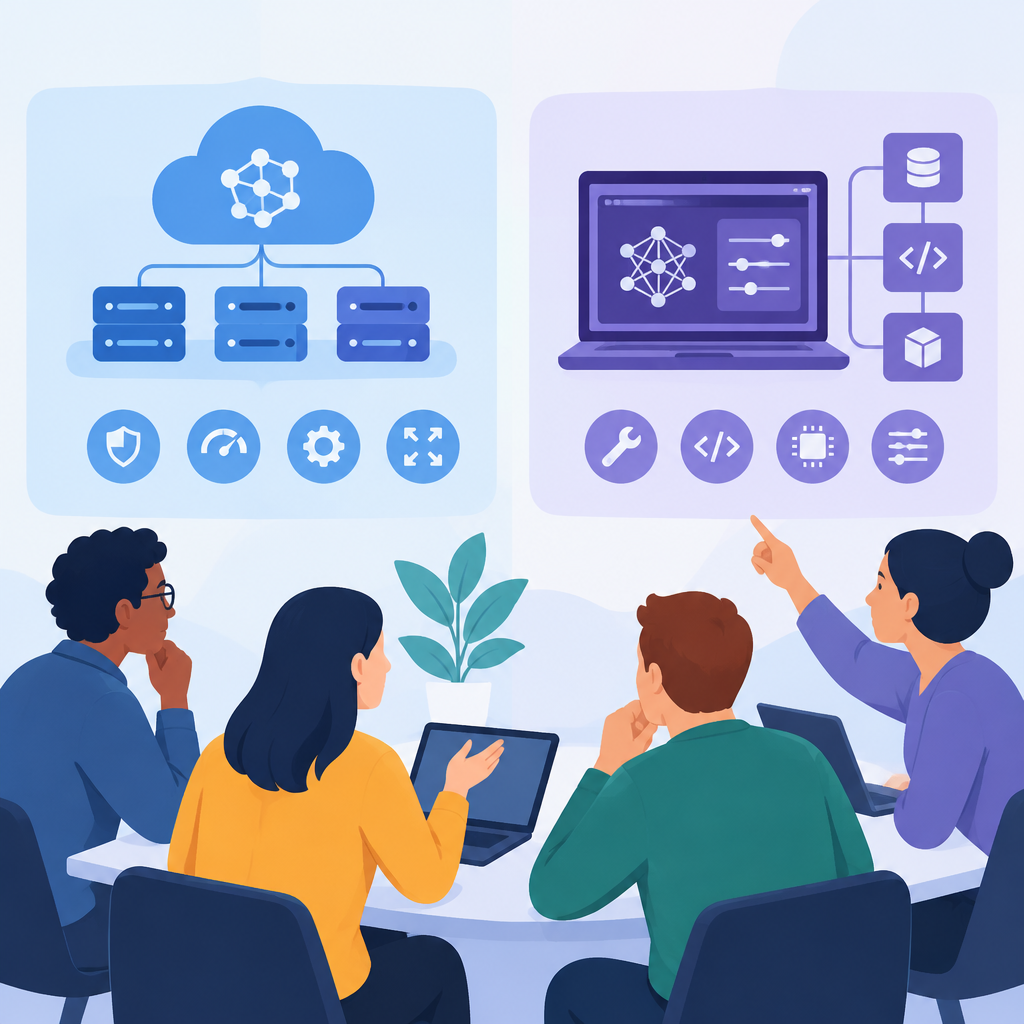
The company’s release says E2E manages model hosting and scaling for Blaze. It describes TIR as supporting self-hosted inference, pre-training and post-training through managed Kubernetes, including serving customers’ own or fine-tuned models. Those are different operating arrangements even though both sit within E2E’s platform.
Blaze’s indexed product page describes one OpenAI-compatible endpoint for open-weight models, with routing and serving infrastructure handled underneath. That wording describes an interface and service proposition. It does not establish that every application feature, model or request format will work unchanged.
Blaze product page: endpoint and serving description
No endpoint, account or model deployment was tested for this article. The sources do not provide enough verified detail here to calculate a customer-specific bill or promise a particular latency. Obtain the applicable model list, rates, limits and service conditions for the workload you intend to run.
Start with an operating-responsibility sheet
Before comparing prices, list five jobs: selecting the model, preparing application requests, operating the model server, observing failures and deciding when a change is acceptable. Beside each job, write the proposed owner and the evidence needed to confirm that responsibility. This is an original planning worksheet, not an official E2E support matrix.
For a managed inference proposal, ask which serving tasks the provider performs and which application tasks stay with your team. For a TIR proposal, ask what your team must configure and maintain within the managed infrastructure. Confirm the boundary explicitly rather than treating the word managed as a complete description of every layer.
Walk through two fictional workloads
Imagine one team building a document-summary application around a model already offered by a provider. Its first discussion could focus on API access, output requirements, usage reporting and service limits. It still needs someone to decide whether the summaries are useful and to handle application failures.
A second fictional team wants to serve its own fine-tuned model. Its discussion would also need to cover the model artifact, supported serving setup and responsibility for deployment changes. E2E’s description of TIR makes that a relevant path to investigate, without proving that the team’s particular model is supported.
Use the same small set of non-sensitive sample documents when comparing proposed setups. Define acceptable output before the evaluation and record the exact model and configuration. Keep observed results separate from supplier claims; a successful sample does not establish production behavior at a different load.
Compare a defined service
End the discussion with a written scope: the model, interface, operating owner, support boundary and evidence still missing. Then compare the quoted service against those requirements. A shared provider name does not make the two paths interchangeable, and a pay-per-token label alone cannot settle the operational choice.