Barmer II–South Kalamb HVDC: What the 6 GW Award Actually Covers
The Barmer II–South Kalamb HVDC project has attracted attention because the headline figure—6,000 MW—sounds like a single, all-inclusive award. The paperwork and company disclosures show something more specific. The award to GE Vernova T&D India is for the converter terminals and related HVDC station scope, while the transmission line work is covered separately under other packages.
In plain language: the project is not one giant contract for every part of the corridor. It is a grouped HVDC system with distinct responsibilities. One set of contracts covers the converter stations that change power from alternating current to direct current and back again. Another set covers the overhead transmission lines and associated line packages. Those are related, but they are not the same work, and one award should not be read as the value or scope of the other.
What the November filings and releases actually say
GE Vernova T&D India’s November 4 exchange filing said it received from POWERGRID a letter of award dated November 3 for the design and establishment of 6,000 MW, ±800 kV line-commutated converter terminals configured as two 3,000 MW bipoles. The filing also said the definitive agreement would follow. That matters, because a letter of award is an important step, but it is not yet the final signed contract package.
GE Vernova’s November 6 release described its scope in more operational terms: converter stations, equipment, site erection, testing and commissioning. It also said the LCC valves would be manufactured at Pallavaram. That language reinforces that GE’s role is centered on the terminal-side HVDC system, not on the entire project corridor.
Separately, POWERGRID’s award documentation identifies Tata Projects on line package TL03, Part III only. That should not be read as covering all line work for the corridor, and it should not be used to infer the value of GE’s converter terminal award. The converter station package and the line package are different contracts with different scopes.
What a converter terminal does
An HVDC link moves electricity in three broad steps. First, AC power from the grid enters the converter terminal. Then the terminal converts that AC into DC for long-distance bulk transfer. At the receiving end, the process is reversed: the terminal converts DC back into AC so the power can enter the destination grid.
That forward flow is the normal operating path for a power transfer project. The terminals are therefore the conversion points, while the overhead line or cable route is the physical path the electricity follows between them. Without the converter stations, the DC link cannot do its job; without the line packages, the terminals have nowhere to send the power.
What 6 GW means—and what it does not mean
The 6 GW figure should be understood as rated transfer capacity, not as generation capacity. It does not mean the project produces 6 GW of electricity on its own. It does not mean 6 GW is always flowing. And it does not, by itself, prove the link is operating in service.
In practical terms, 6 GW is the designed amount of power the HVDC system is intended to transfer under specified operating conditions. Actual delivery will depend on system readiness, grid conditions, dispatch decisions, and commissioning status. So the number is a technical rating, not a statement of guaranteed output or real-time energy delivered.
What “two 3,000 MW bipoles” means
A bipole is a pair of transmission poles, or conductors, that work together in an HVDC system. Saying the project is configured as two 3,000 MW bipoles means the 6,000 MW scheme is split into two 3 GW blocks. In simple terms, that gives the system a divided structure rather than one single undivided path.
However, bipole configuration should not be casually translated into guaranteed redundancy. Whether one part can keep operating if another part is down depends on the detailed engineering, operating scheme, and project design. The award description alone does not justify assuming full backup capability or uninterrupted service under every fault condition.
Why the line package is separate from the terminal package
The conversion terminals and the transmission line packages are different parts of the same system. The terminal package covers the electrical conversion infrastructure, control systems, erection, testing, and commissioning. The line package covers the towers, conductors, and the overhead corridor that carries power between stations.
That separation is common in major grid projects because the skills, procurement, and construction methods differ. It also means readers should be careful not to add together unrelated package values or assume that one company’s award tells the whole commercial story for the corridor.
Practical checklist for following the project
- Definitive agreement: watch for the signed contract that follows the letter of award and clarifies final commercial and technical terms.
- Terminal progress: track design finalization, equipment manufacturing, site erection, and any milestones tied to converter station readiness.
- Line progress: distinguish the terminal scope from the separately tendered or awarded line packages, including TL03, Part III as disclosed.
- Integration and testing: look for evidence that the converter terminals, protection systems, controls, and line interfaces are being tested together.
- Commissioning status: confirm when the project moves from construction and testing into operational readiness and then service.
- Scope discipline: verify whether any new disclosure refers to station work, line work, or both before drawing conclusions about the total project scope.
Bottom line
The headline 6 GW award is about HVDC converter terminals and their associated station scope. It is not a shorthand for every piece of the Barmer II–South Kalamb corridor. The line packages are separate, and the filings and release materials should be read that way. For readers following the project, the most useful question is not just “How big is the award?” but “Which part of the system does this award actually cover?”
POWERGRID award record for line package TL03
GE Vernova press release on the 6 GW HVDC project
GE Vernova T&D India filing PDF
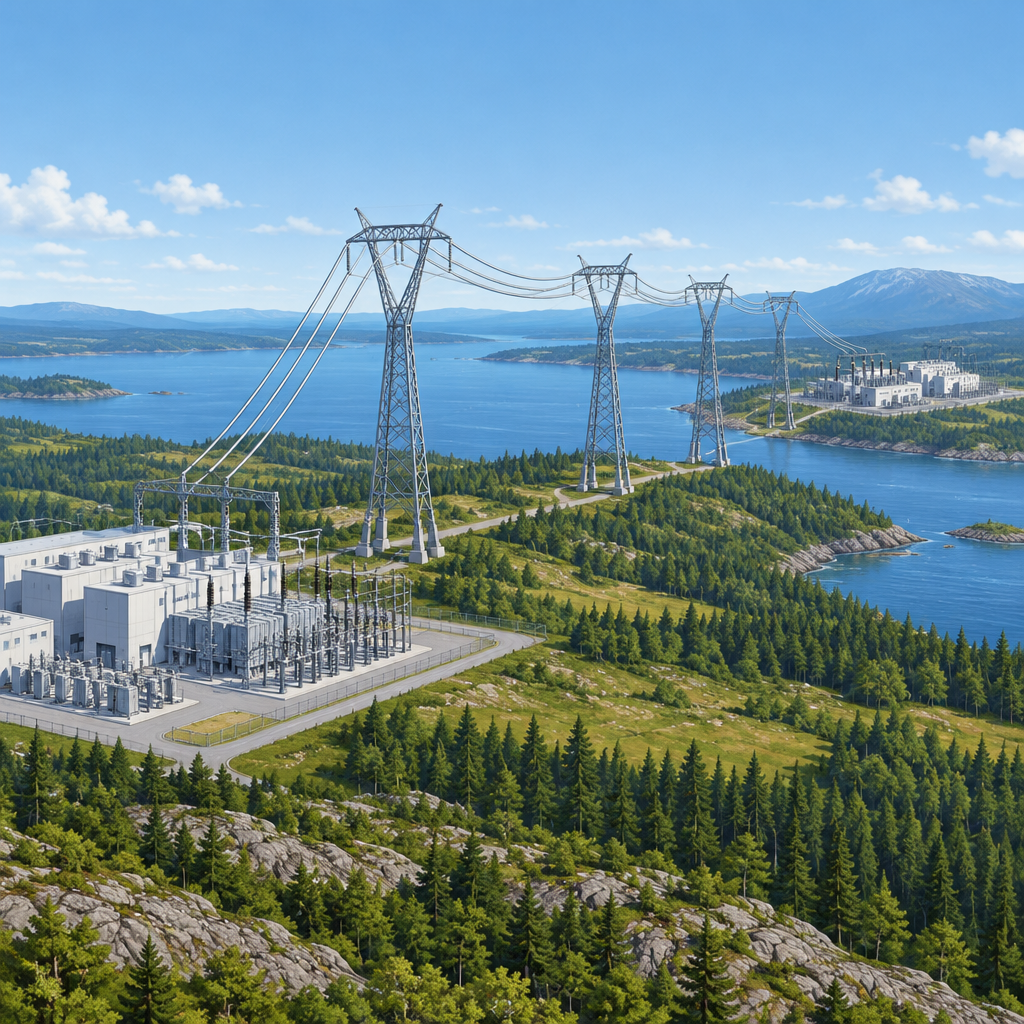
Conceptual illustration of converter stations connected by overhead transmission lines; not a photograph of the Barmer II–South Kalamb project.