Start with three separate recovery checks
AWS announced on Nov. 6 that Amazon MSK Replicator is available in additional AWS regions, including AWS GovCloud (US-East) and GovCloud (US-West). For teams running streaming infrastructure across regulated or isolated environments, that makes failover drills more practical—but also more important to plan carefully. A drill should verify what was replicated, what consumers processed, and whether the business can resume service within an acceptable recovery window.
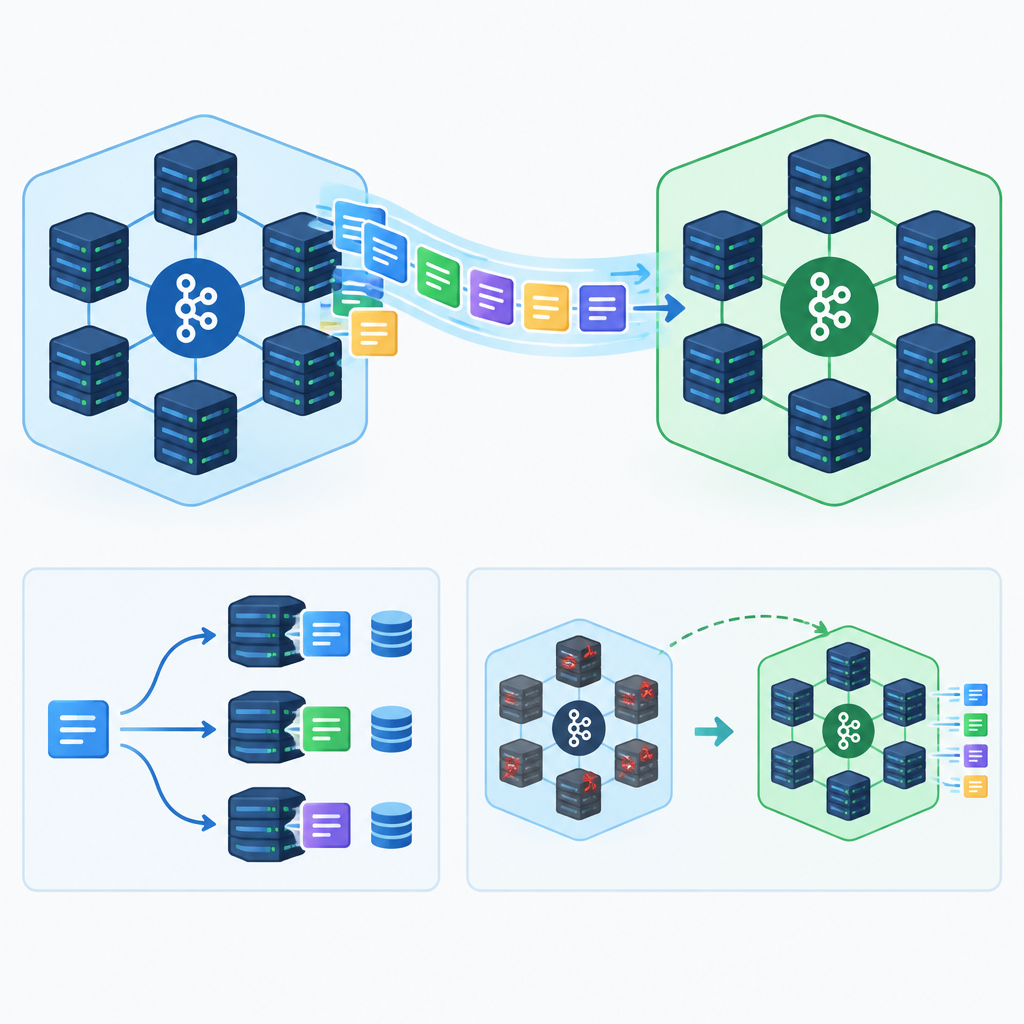
Separate replication checks from recovery checks
Do not treat “replication succeeded” as the same thing as “the workload recovered.” MSK Replicator is asynchronous and at-least-once, so a disruption can still leave missing data in an unplanned outage or cause duplicate processing after failover. Also, translated offsets do not have to equal the original source offsets, so offset matching alone is not a valid success signal.
Before the drill, define a pass criterion for each layer. Decide which test records must arrive, how you will detect reprocessing or gaps after consumers restart, and how quickly the application must resume the expected behavior.
Use a controlled record sequence
Build the drill around fictional, nonproduction records with sequence tags. A simple pattern might be event IDs such as 1001, 1002, 1003, and 1004 written to the source cluster in order. After replication and failover, inspect the target cluster for missing IDs, reordered records, and duplicates. Because MSK Replicator provides asynchronous delivery, it is possible to see both late arrivals and repeated records during recovery.
Record the last committed source position, the first event the target consumer actually processes, replication lag, and elapsed recovery time. Use event IDs to compare records across clusters; subtracting Kafka offsets across clusters does not measure lag.
What to verify in the setup
- The source and target MSK clusters are in the same AWS account, because MSK-to-MSK replication must follow that requirement.
- The target environment is a true recovery target, not a production system with hidden dependencies on the source cluster.
- The drill plan does not assume automatic traffic switch; route changes, DNS updates, or client reconfiguration may still be manual.
- The team does not assume support for every cross-partition or cross-topic pattern unless it has been explicitly validated in the workload being tested.
Use AWS guidance as the reference point
AWS documents the multi-Region design pattern and troubleshooting guidance for MSK Replicator. Those references are the right starting point for planning the drill and investigating anomalies, but they do not guarantee a business-ready failover on their own. The safest approach is to test your own producers, consumers, lag monitoring, and recovery steps in the exact topology you intend to use.
If the drill passes, document the evidence: which records were expected, which were observed, what duplicates appeared, how long recovery took, and which manual steps were required. If it fails, the value is still real: you have found the gap before an outage exposes it.
AWS announcement: Amazon MSK Replicator in additional AWS regions