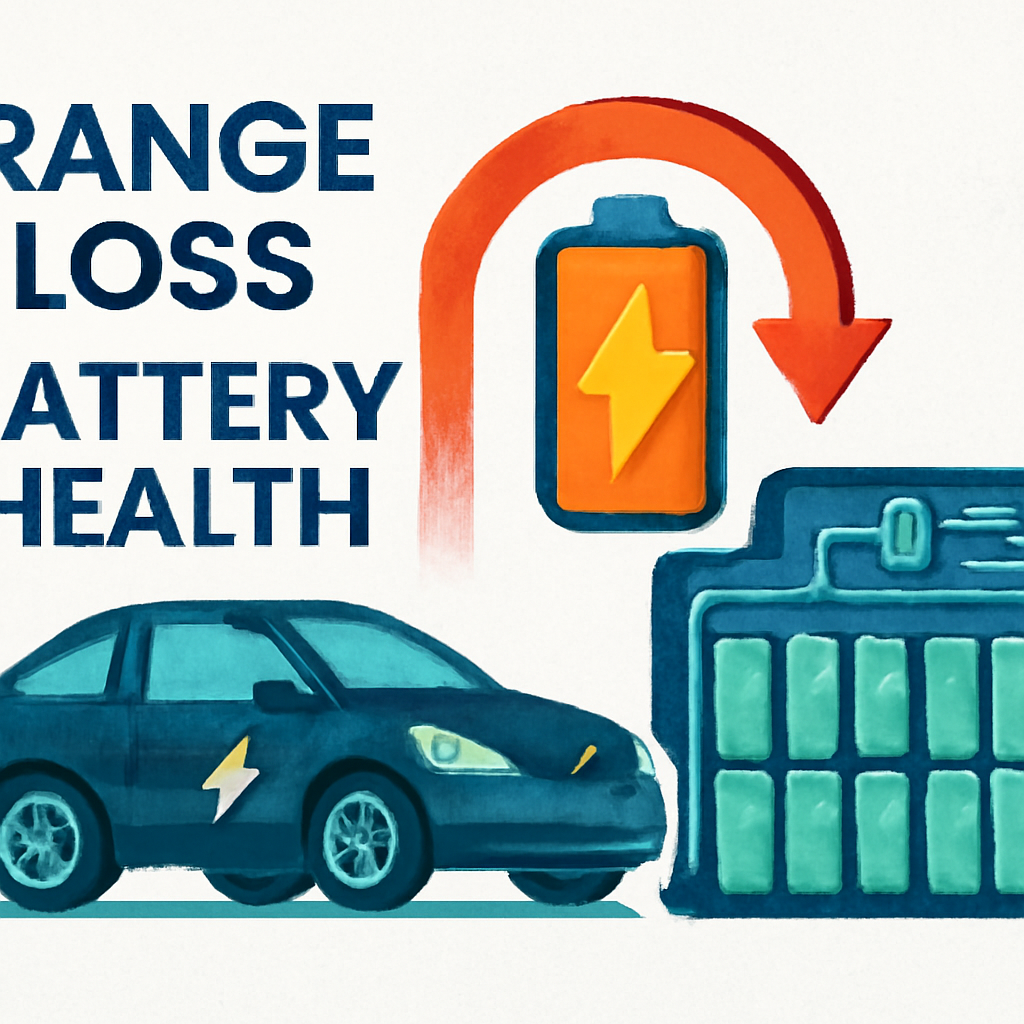
Why EV Range Changes: Battery Health, Conditions, and Real-World Use.
Electric vehicle (EV) owners often notice that the displayed range changes from one day to the next. That can be confusing, especially if the number looks lower than expected. The important thing to know is that range is not only about battery size. It is also shaped by temperature, driving speed, traffic, load, tyre condition, air-conditioning use, and how the car’s software estimates energy use. Some range loss is temporary. Some is gradual battery aging. These are not the same thing.
State of Charge, State of Health, and Estimated Range
Three different ideas are easy to mix up. State of charge (SoC) is the battery’s current charge level, like a fuel gauge. State of health (SoH) is a measure of how much usable capacity the battery can still provide compared with when it was new. Estimated range is the car’s prediction of how far you can drive based on current charge, recent efficiency, and conditions. A low range estimate does not automatically mean the battery is badly degraded. It may simply reflect cold weather, high-speed driving, or heavy air-conditioning use.
Temporary Range Losses Are Common
Many range drops are temporary and reversible. Cold weather can reduce efficiency because the battery and cabin need energy to warm up. Hot weather can increase HVAC demand. Driving at higher speeds usually consumes more energy than urban traffic at moderate speeds. Tyres with low pressure, aggressive acceleration, hilly routes, and extra passengers or cargo all raise consumption. In many EVs, the battery-management system also protects the battery by limiting output in extreme conditions, which can affect range display and performance. This is normal behavior, not necessarily damage.
For example, an EV that usually delivers strong range in mild weather may show a lower estimate on a cold morning with the heater on. That does not prove permanent battery loss. It may simply mean the car expects to use more energy per kilometre on that trip.
Illustrative Example: Why the Same Battery Can Show Different Range
Illustrative example only: imagine an EV with 60 kWh of usable battery capacity. If the car consumes about 0.15 kWh per kilometre, the theoretical range is 400 km. But if driving conditions raise consumption to 0.20 kWh per kilometre, the same battery may only provide about 300 km. In this example, the lower range comes from higher energy use, not necessarily from battery degradation.
What Battery Aging Really Means
Over time, all rechargeable batteries lose some capacity. That process is called aging or degradation. It can happen gradually through normal use, time, heat exposure, frequent fast charging, and long periods of sitting at very high or very low charge. As the battery ages, the usable energy stored in it slowly decreases, so the car may travel fewer kilometres on a full charge than when it was new. The key idea is that permanent aging usually changes the battery’s actual usable capacity, not just the dashboard estimate for one trip.
Battery-management systems help protect cells by balancing them, controlling charging and discharging, and preventing unsafe operation. But the figures shown by the car are estimates from its own sensors and algorithms, not universal lab measurements. Different brands may calculate range and health differently, so numbers are useful, but they should be interpreted in context.
What About Charging Habits?
There is no single charging rule that fits every EV. A common myth is that all EVs should always be charged only to 80%. In reality, charging guidance depends on the model, the battery chemistry, and the manufacturer’s instructions. Some lithium iron phosphate (LFP) batteries may be managed differently from other chemistries. The safest advice is simple: follow the vehicle manual and the brand’s guidance for daily charging and long trips. Do not assume one rule is correct for every EV.
Used EV Checklist: What to Ask Before You Buy
- Ask for a dated diagnostic report that shows battery-related checks performed by a qualified service centre.
- Request the method used to measure battery health or usable capacity, if available, so you know whether the figure comes from the vehicle, a scan tool, or a service inspection.
- Look for the usable battery capacity figure when available, not just the displayed range.
- Review the fault and service history for battery, charging, thermal-system, and powertrain issues.
- Read the warranty terms carefully, including battery coverage, mileage limits, and whether the warranty transfers to the next owner.
- Take a realistic test drive that includes city streets, stop-go traffic, and normal speeds, because a short showroom drive may not reflect real-world use.
Avoid any inspection method that requires opening the high-voltage battery pack yourself. High-voltage systems are dangerous and should only be handled by trained technicians.
Practical Tips for Owners
- Expect range to change with weather and driving style.
- Check tyre pressure regularly because underinflation can raise energy use.
- Use the car’s own efficiency display, but remember it is a model-based estimate.
- Read the owner’s manual for charging limits and battery-care guidance.
- If a range drop looks sudden or unusual, ask a qualified service centre to inspect the vehicle.
FAQs
Q: Does a lower range estimate always mean battery damage? No. It often reflects temperature, speed, HVAC use, traffic, route, or load. Permanent degradation is a separate issue.
Q: Can I judge battery health only from the dashboard range? Not reliably. Range is an estimate, while battery health is about usable capacity and cell condition. A proper diagnostic report is better for used-car decisions.
Q: Should I always charge to 80%? Not always. Follow the manufacturer’s guidance for your exact model and battery chemistry. Some batteries, including some LFP-based packs, may have different advice.
Q: Can I check the battery pack myself? No. Never attempt DIY access to high-voltage components. Use trained EV technicians only.
Conclusion
EV range is shaped by both physics and software. Some changes are temporary and caused by weather or driving conditions. Others come from long-term battery aging. Understanding the difference helps owners avoid unnecessary worry and helps used-EV buyers ask better questions. If you know what SoC, SoH, and estimated range actually mean, you can make smarter charging, driving, and buying decisions.
Primary Sources
U.S. Department of Energy: Winterizing Your Electric Vehicle
Explains how cold weather affects EV performance, range, and cabin heating needs. Useful for understanding temporary range loss in winter.
Australian Government: Electric Vehicle Batteries and Motors
Overview of how EV batteries and motors work, including the role of battery systems in storing and delivering energy.
Australian Government: Electric Vehicle Maintenance and Servicing
General maintenance guidance for EV ownership, including service considerations and what routine care may involve.
U.S. DOE AFDC: Electric Vehicle Maintenance
Summarizes EV maintenance topics and helps readers understand which components differ from conventional vehicles.
Explains common factors that affect EV range in everyday driving. Manufacturer guidance can vary by model.