Quick answer
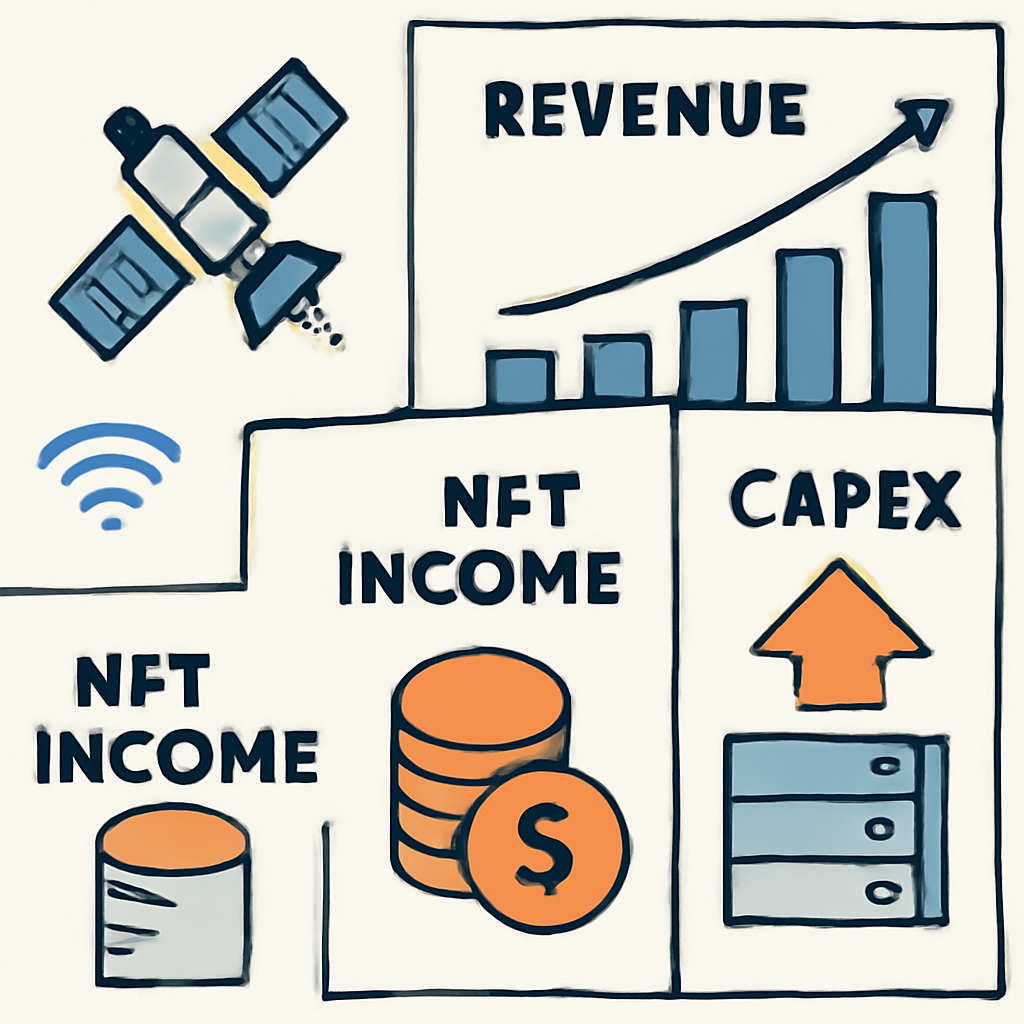
SpaceX’s Q3 2026 filing shows a business that is profitable at the operating and net-income level, but also spending heavily on long-lived infrastructure. The main numbers are not contradictory: revenue was $14.575 billion, operating income was $2.791 billion, net income was $4.4 billion, adjusted EBITDA was $8.809 billion, and total capital expenditure was $19.593 billion. The right way to read the filing is to treat profit and capex as different layers of the business, not as numbers that should be subtracted from each other line by line.
Filing scorecard
Below is a compact scorecard built from SpaceX’s SEC-filed earnings release for the quarter ended September 30, 2026. The company’s business is organized here into Space, Connectivity, and SI, with capex shown separately because it is a cash investment, not a same-line expense.
- Total revenue: $14.575B, up 161% year over year
- Operating income: $2.791B
- Net income: $4.4B
- Adjusted EBITDA: $8.809B
- Total capital expenditure: $19.593B
- Space revenue: $1.767B; operating loss: $7M
- Connectivity revenue: $5.248B; operating income: $2.367B
- SI revenue: $7.560B; operating income: $431M
- Starlink consumer subscribers: 13.6M versus 7.2M a year earlier
- Starlink consumer ARPU: $69/month versus $83 a year earlier
- Nameplate compute: 1.7GW
- SI capex: $16.444B
What the headline profit proves, and what it does not prove
The headline net income number proves that SpaceX was profitable for the quarter on a GAAP basis. But net income does not mean the same thing as operating profit, and it does not mean the same thing as cash generated after investments. Net income can be affected by below-the-line items such as taxes, interest, and other accounting effects. That is why investors and readers should not collapse every number into one line and call it “the real profit.”
One especially important distinction: adjusted EBITDA is non-GAAP. It is often used to describe operating performance before some non-cash or non-operating items, but it is not a substitute for GAAP net income. In the filing, SI operating income also includes $1.2 billion of share-based compensation related to the Cursor acquisition, which helps explain why readers should inspect segment notes instead of relying on a single headline number.
Why capex above quarterly revenue is not automatically a contradiction
Capex is capital expenditure: money spent to build or acquire assets that are expected to help the business over time. It is not recorded as a one-quarter operating expense in the same way that payroll or rent is. Instead, capex is capitalized and then recognized over time through depreciation or amortization, depending on the asset. That is why capex cannot simply be subtracted from quarterly net income.
For Q3 2026, total capex of $19.593 billion was larger than revenue of $14.575 billion. That sounds extreme, but it is not a mathematical error. It means the company was investing very aggressively in future capacity, infrastructure, or both. In other words, the quarter mixes current-period earnings with a much larger build-out program that will show up in later periods through depreciation, utilization, and future revenue potential.
Segment mix: SI is the largest revenue source, while Connectivity drives the most operating profit
The revenue mix matters because the biggest segment by sales is not necessarily the biggest contributor to operating profit. In this filing, SI generated the most revenue at $7.560 billion, followed by Connectivity at $5.248 billion and Space at $1.767 billion. But Connectivity produced the largest operating income at $2.367 billion, ahead of SI at $431 million.
That split suggests a business with one large, lower-margin growth engine and another segment that is converting revenue into operating profit more efficiently. Space, by contrast, was essentially breakeven to slightly negative at the operating line, with a $7 million loss.
Starlink scale versus ARPU
The consumer side of Starlink is clearly scaling. Subscribers rose to 13.6 million from 7.2 million a year earlier, an editorial calculation of about 88.9% growth. But average revenue per user, or ARPU, fell to $69 per month from $83, a decline of about 16.9%.
That combination matters. More subscribers usually help total revenue, but lower ARPU can mean the company is broadening access, shifting geography, offering different plans, or trading per-user monetization for faster adoption. Readers should not assume that subscriber growth alone tells the full revenue story.
A reusable five-step filing checklist
- Step 1: Start with revenue, operating income, net income, and adjusted EBITDA separately. Do not merge them into one “profit” bucket.
- Step 2: Check whether the company is using GAAP or non-GAAP measures, and note which items are excluded or adjusted.
- Step 3: Read segment revenue and segment operating income together to understand which parts of the business are actually carrying earnings.
- Step 4: Separate capex from operating expenses. Capex is a cash investment in assets, not a same-line deduction from net income.
- Step 5: Compare the quarter with prior-year figures and then ask what changed in mix, scale, and capital intensity.
Practical worksheet
The following ratios are editorial calculations based on the filing. They are not company guidance.
- Operating margin = 2.791 / 14.575 = about 19.1%
- Net margin = 4.4 / 14.575 = about 30.2%; net income is below-the-line and is not the same as operating profit
- Capex / revenue = 19.593 / 14.575 = about 134.4%
- SI share of revenue = 7.560 / 14.575 = about 51.9%
- SI share of capex = 16.444 / 19.593 = about 83.9%
- SI capex / SI revenue = 16.444 / 7.560 = about 217.5%
- Starlink consumer subscriber growth = (13.6 - 7.2) / 7.2 = about 88.9%
- Starlink ARPU change = (69 - 83) / 83 = about -16.9%
These ratios are useful because they force a reader to answer different questions: how much revenue turns into operating profit, how much of that profit is below the line, and how much capital the company is deploying relative to current sales.
What to watch next
- Q4 capex execution, including Reuters’ report that management expects $35B to $40B in Q4 capex; that is a reported expectation from the earnings call, not a Q3 actual
- SI operating income, especially whether the acquisition-related compensation line remains unusually large
- Cash flow, because capex affects cash flow and future depreciation rather than being a direct offset to quarterly net income
- Subscriber and ARPU tradeoff, since growth in users and revenue per user can move in opposite directions
- Compute utilization, especially given the reported 1.7GW nameplate compute figure
- Segment disclosure consistency, so future quarters can be compared cleanly with this one
AP reported a 7.5% after-hours share move, which is useful market context but not a recommendation or forecast.
Can you read these filing numbers correctly?
Quiz explanations
- Capex above revenue does not automatically mean a net loss. Capex is investment in long-lived assets, not a same-line operating expense.
- SI had the most revenue at $7.560 billion.
- Connectivity contributed the most operating income at $2.367 billion.
- Capex should not be subtracted directly from quarterly net income; it affects cash flow immediately and earnings over time through depreciation or amortization.
FAQ
Is adjusted EBITDA the same as profit?
No. Adjusted EBITDA is a non-GAAP measure that removes certain items to show operating performance in a different way. It can be useful, but it is not the same as GAAP net income.
Why does net income exceed operating income here?
Because net income includes below-the-line items that can move the total above operating income. Readers should inspect the full filing to understand what drove the difference.
Does a large capex number mean the business is unhealthy?
Not by itself. Large capex can mean the company is building capacity aggressively. The key questions are whether the spending is tied to a plausible growth plan, how it affects cash flow, and whether returns show up later.
What is the most important takeaway for non-specialists?
Separate profit from investment. A quarter can be profitable and still be dominated by heavy capex. The filing should be read as an operating result plus a build-out decision, not as one blended number.
Sources
- SEC filing / primary earnings release: https://www.sec.gov/Archives/edgar/data/1181412/000162828026066482/spaceexplorationtechnologi.htm
- SpaceX investor event page: https://ir.spacex.com/events/event-details/2026/Q3-2026-Earnings/default.aspx
- Reuters, October 20, 2026: https://www.reuters.com/business/media-telecom/spacex-quarterly-revenue-jumps-beats-estimates-ai-business-surges-2026-10-20/
- AP, October 20, 2026: https://apnews.com/article/spacex-musk-turns-profit-losses-67064446bf0afdf529db55bdec82af69