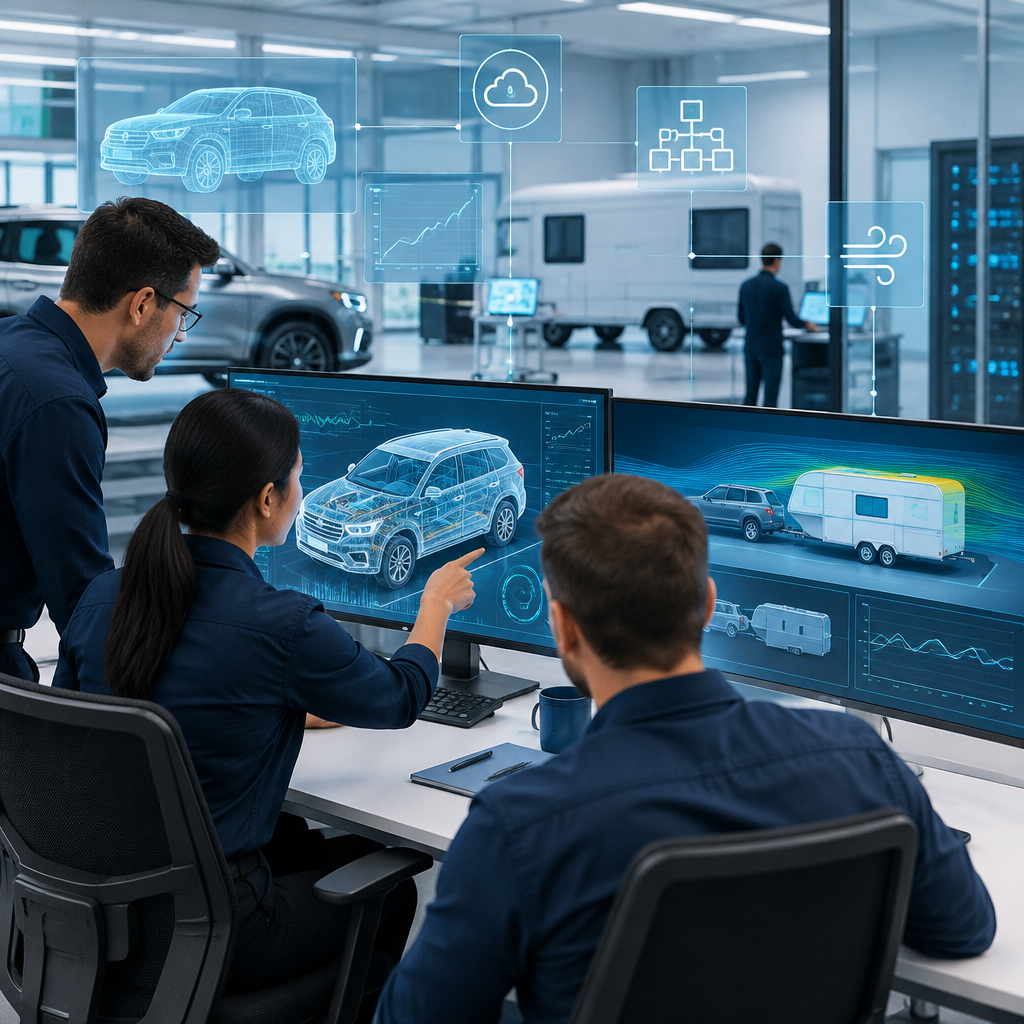
What Toyota tested before vehicle hardware was ready
Woven by Toyota said on November 9 that engineers developing the 2027 Toyota Sequoia and Tundra used Arene to test how the multimedia system and the driver-assistance controller exchanged trailer data before the necessary hardware was available. Toyota highlighted Arene again at its November 11 technology showcase. The engineering question was simple: after a trailer profile changes on one screen, does the other system use the new information?
Why a trailer profile matters in software development
A trailer profile stores details such as the trailer’s size and type. The multimedia system sends that information to the driver-assistance electronic control unit, or ECU. If the two systems interpret the same fields differently, the screen can show a saved update while the receiving software still uses earlier data.
How Trailer Garage passes data to the controller
Trailer Garage is the menu in the vehicle’s multimedia system where drivers can save or update trailer details. It was part of the workflow the engineers tested. Arene supplied the simulated environment and virtual vehicle network, so the multimedia and driver-assistance software could exchange data before the physical components were ready.
How software-in-the-loop testing fits in
Software-in-the-loop testing runs the software while simulating the hardware and network it normally uses. In Toyota’s case, the two software stacks could communicate over a virtual vehicle network. That let engineers check how the receiving system interpreted the profile before testing on physical equipment.
An illustrative lab exercise: one synthetic update and a stale-data check
For a lab exercise inspired by this example, start with a synthetic profile and confirm the receiving service logs it. Update one field, such as trailer type, and confirm that the receiver reports the new value after the update is accepted. Then replay the earlier test message. The check passes if the receiver still reports the newer profile; if it reverts, record the input sequence and the first point where the two sides disagree. This is a suggested test, not a description of Toyota’s internal procedure.
That said, simulation has limits. A virtual test bench cannot fully reproduce vibration, sensor noise, weather, driver behavior, or all the unpredictable interactions that happen in the real world. So while SIL is a powerful development tool, it does not replace physical validation. It helps narrow the problem space before engineers move on to more complete testing.
What the Nov. 11 showcase signals—and what it does not
Toyota used the November 11 showcase to describe the platform’s direction. It plans to extend Arene to approximately 50 models and 10 million vehicles worldwide by 2030. Those figures are targets; the Sequoia and Tundra example describes work already reported by Woven. A successful lab test does not establish availability by trim or market, or replace validation on actual hardware.
Why this matters for automotive software
The larger lesson is that modern vehicle development is increasingly about data flow, software architecture, and testability. A trailer profile may sound like a narrow topic, but it illustrates a broad shift: engineers are designing digital systems that can be tested earlier, iterated faster, and validated more systematically. Toyota Arene appears to be one of the company’s tools for that shift, connecting simulation, control logic, and platform development into a more software-centric workflow.
Sources
Woven by Toyota: Arene expands to the Sequoia and Tundra
Toyota USA: November 11 mobility and manufacturing showcase