IBM, Oak Ridge National Laboratory’s Quantum Science Center and AMD announced a quantum error-correction co-design platform on November 5, 2026. Its useful lesson for readers comparing quantum-computing progress is that the classical work belongs on the performance timeline too.
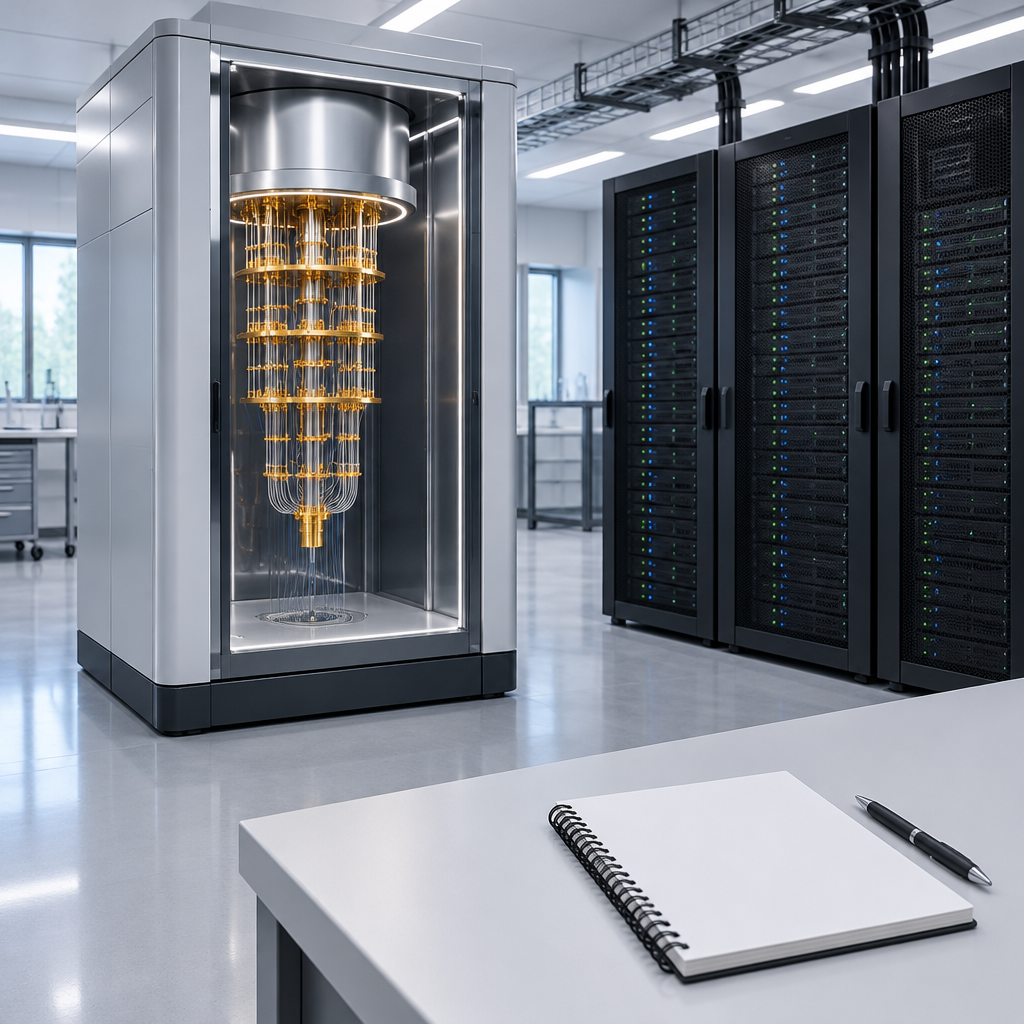
The announcement combines two kinds of computing
IBM describes a deployment at its Poughkeepsie site that pairs Nighthawk quantum processors with ORNL’s Umbra high-performance computing system, powered by AMD GPUs and CPUs. Its technical overview says nearby classical hardware enables low-latency quantum–classical execution.
The same overview explains that quantum error correction depends on decoders: classical software that identifies qubit errors and must keep pace with the quantum processor. A GPU in this arrangement supplies classical computing; its presence should not be counted as additional quantum qubits.
Ask where the clock starts and stops
When evaluating a reported improvement, ask which part of the workflow was measured. A number describing the decoder’s computation alone answers a narrower question than one covering the movement of measurement data and the subsequent control action. Retain the author’s actual measurement boundary rather than silently treating the numbers as interchangeable.
- Input: what measurement data reaches the decoder, and when?
- Computation: which decoding task, hardware and workload were timed?
- Movement: does the measurement include communication and waiting?
- Output: when is the result available to the next stage?
These are proposed reading questions, not a description of a published Umbra timing result. The announcement does not supply a universal decoder-latency figure for every error-correction method.
Try an explicitly fictional timing example
Imagine an invented, strictly serial teaching model with three stages: moving data takes two time units, decoding takes three, and returning a control result takes one. Its total is six units. If decoding alone becomes twice as fast, that stage takes 1.5 units and the new total is 4.5 units.
The complete toy workflow is therefore 6 ÷ 4.5, or about 1.33 times as fast, even though its decoder is twice as fast. This arithmetic assumes no overlap and unchanged surrounding stages. Real systems may pipeline work, incur other delays or use different dependencies, so this example is not an IBM benchmark or a prediction for the platform.
Keep the research milestone attached to its evidence
IBM presents the platform as a way to evaluate quantum and classical integration for error-correction research. It describes that work as contributing toward future scientifically relevant computing. A deployed research platform and an achieved future performance target are separate milestones; the launch alone cannot establish the latter.
For a useful comparison sheet, record the date, quantum device, classical hardware, decoding method, measured boundary and reported uncertainty. Leave unavailable fields marked unknown. Then ask whether two results measure the same work before ranking them.
No quantum program, decoder or timing experiment was run for this article. Its contribution is a reading method and a labeled arithmetic example, intended to make the next technical result easier to assess.