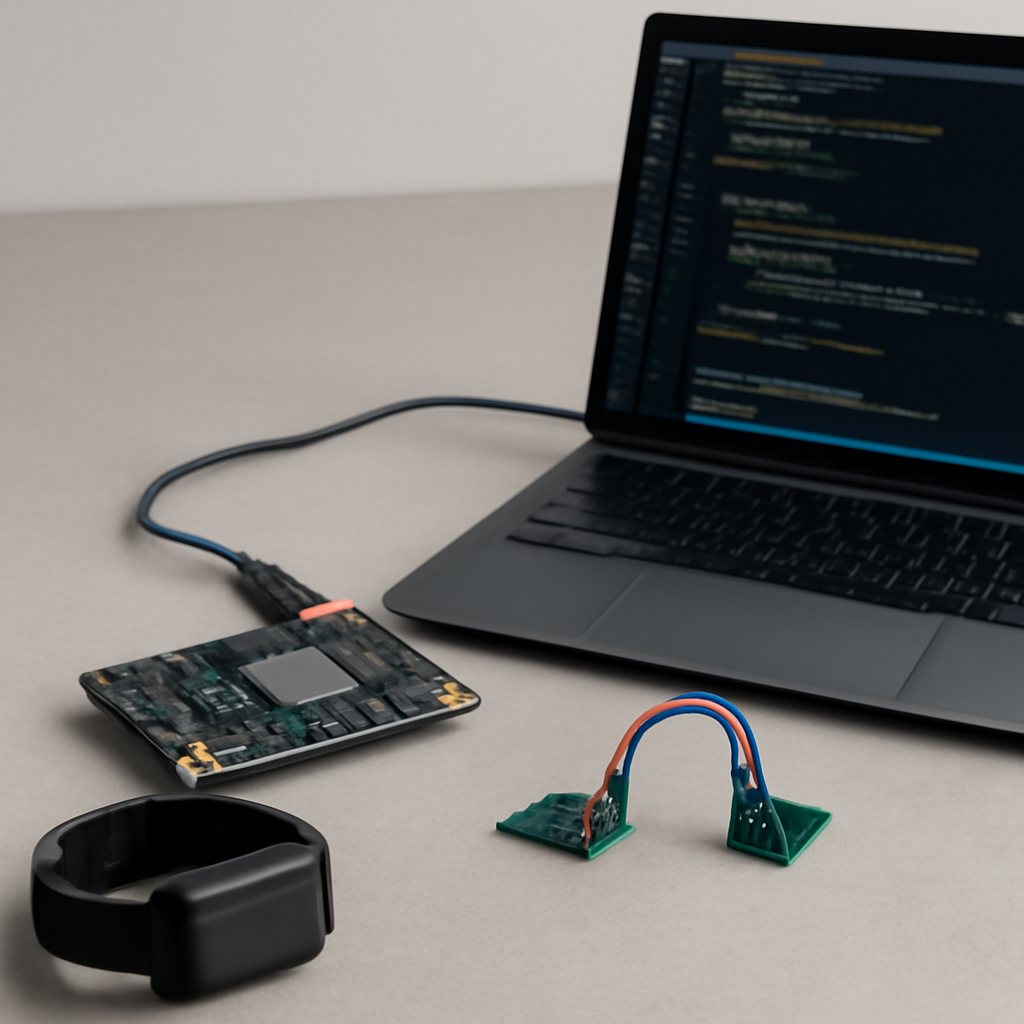
Lead: the short answer for builders and product teams
Google’s Coral NPU has crossed an important threshold: as of October 20, 2026, the project is no longer just a chip concept or a compiler experiment. Google says the 32-bit Coral NPU architecture is complete, the v1.0 IREE/MLIR compiler path is available, and partner hardware is starting to arrive. That makes Coral a real open-edge-AI stack worth testing. But it is not yet a universal buying decision. The practical question is not whether Coral exists; it is whether your models, latency target, power budget, software path, and supply-chain needs fit what is verified today rather than what is promised for later.
What changed on October 20, 2026
The key change is that Coral moved from a mostly architectural and ecosystem story into a layered, testable platform. Google’s announcement frames the stack as open NPU RTL, a compiler/toolchain, simulation and prototyping support, and commercial silicon or dev boards. In parallel, Synaptics said it is expanding the Coralboard ecosystem, and public repositories for the Coral NPU RTL and compiler are live. A DigiKey listing also indicates commercial availability pressure is now real, even if production readiness still depends on your exact SKU and supply plan.
That said, the announcement does not erase the usual embedded-AI gaps: independent benchmark coverage is still thin, only one major commercial silicon partner is clearly visible at launch, pricing for some new SR200/Coralboard SR items is still not well established publicly, and roadmap items such as 64-bit and CHERI support should be treated as roadmap claims, not delivered capabilities.
The Coral stack in four layers
To evaluate Coral correctly, separate the stack into four layers. Each layer has a different maturity level and a different risk profile.
- Open NPU RTL: Google has published the Coral NPU architecture and RTL in open repositories. This is the most concrete part of the stack and the best place to inspect interface choices, datapath assumptions, and what the design actually supports in hardware.
- Compiler/toolchain: The Coral NPU compiler repository and v1.0 IREE/MLIR path are what make the architecture useful to developers. This is where model conversion, operator lowering, and deployment friction either disappear or become your main integration burden.
- Simulation/prototyping: This is the bridge between open IP and real silicon. It helps teams verify functionality, debug models, and evaluate behavior before hardware is in hand, but it is not the same thing as validated production throughput or production thermals.
- Commercial silicon/dev boards: This is where the stack becomes buyable and testable in an actual product workflow. It is also where supply, lifecycle, software support, and pricing become business constraints rather than engineering abstractions.
Compact comparison table
- Open NPU RTL — verified status: open-source and publicly accessible; headline claim: open 32-bit Coral NPU architecture; what you must validate: feature completeness, synthesis fit, memory behavior, and whether the RTL aligns with your process, security, and certification needs.
- Compiler/toolchain — verified status: public repositories and announced v1.0 IREE/MLIR path; headline claim: portable model-to-silicon compilation; what you must validate: operator coverage, fallback behavior, debugging quality, and whether your model exports without expensive rewrites.
- Simulation/prototyping — verified status: announced and supported by the public stack, but not a substitute for your own measurements; headline claim: early validation before silicon; what you must validate: timing realism, profiling accuracy, and whether simulation matches the eventual board you would ship.
- Commercial silicon/dev boards — verified status: partner hardware and listings are appearing, but production readiness varies by SKU; headline claim: usable edge-AI hardware is arriving; what you must validate: availability, board support package quality, thermal margins, pricing, and lifecycle commitments.
Why the headline performance numbers are not directly comparable
Google’s “up to 1 TOPS” claim, Synaptics’ 400 GOPS Astra SR200 MCU claim, and the 1 TOPS Coralboard SL headline are not apples-to-apples. Those figures can describe different precisions, different kernels, different memory assumptions, different power states, and different duty cycles. A wearable doing intermittent keyword spotting is not the same workload as a camera running continuous object detection. A 10 mW average inference figure can be impressive for one duty cycle and misleading for another if it assumes sparse invocation, ideal quantization, or an especially favorable model path.
So the right question is not “which number is bigger?” It is: what model runs, at what precision, with what memory traffic, on what software path, at what sustained power, and with what fallback behavior when an operator is not accelerated? If your product must run continuously, the average and thermal profile matter more than peak TOPS or GOPS. If your product is bursty, the wake-up time, host overhead, and integration cost may matter more than raw throughput.
What is genuinely usable now
Based on the public evidence, several pieces are usable now in a developer evaluation sense. The open RTL gives teams something concrete to inspect. The compiler repo and IREE/MLIR path give software teams a real deployment path to try. The Google Coral documentation provides a vendor-maintained starting point. Commercial announcements and at least one live product listing indicate that dev hardware or partner boards are moving from roadmap into market reality.
What is not yet fully proven is broad, repeatable production suitability across multiple vendors and product classes. A stack can be open, elegant, and still not be the right fit if your target workload relies on unsupported operators, if your product depends on a strict long-term supply commitment, or if the debug story is not mature enough for a commercial launch.
What Coral NPU does not prove yet
- Independent benchmark gaps: there is not yet a deep body of third-party, workload-specific benchmarks that let buyers compare Coral against incumbent proprietary NPUs, edge GPUs, or MCU accelerators on equal footing.
- Major commercial partner concentration: the launch story appears to have one major commercial silicon partner front and center, which is meaningful but not the same as a broad multi-vendor ecosystem.
- Unknown production pricing for new SR200/Coralboard SR: public listings and announcements help signal availability, but they do not automatically establish final BOM economics or volume pricing for your program.
- Roadmap status of 64-bit and CHERI support: treat these as future capabilities or exploration topics unless and until the vendor documentation clearly states they are delivered, supported, and production-validated.
Five tests every team should run before choosing Coral
- Model/operator compatibility: can your real model compile without major graph surgery, custom kernels, or unacceptable accuracy loss? Test your actual operators, not a toy model.
- End-to-end latency and CPU fallback: measure full pipeline latency from sensor input to output, including preprocessing, host interaction, and any fallback operators that escape NPU acceleration.
- Sustained power and thermal behavior: run long-duration tests at realistic duty cycles, enclosure conditions, and ambient temperatures. Peak efficiency is not the same as sustained behavior.
- Toolchain and debug maturity: check the quality of logs, profiler output, error messages, simulator fidelity, and whether your team can root-cause failures without vendor hand-holding.
- Supply, support, and production lifecycle: verify board availability, lifecycle commitments, software maintenance, security updates, and whether your OEM or EMS can actually source the parts you need.
Business implications: where Coral fits, and where it may not
For technology leaders, Coral’s open path changes the buying conversation. Proprietary NPUs can still win when a vendor offers a mature SDK, guaranteed lifecycle, and a known deployment path with lower integration risk. General-purpose edge GPUs can be better when your workload is flexible, your software stack is already CUDA- or GPU-centric, or you need faster time-to-train and time-to-debug across many models. MCUs with accelerators often make more sense in ultra-low-power wearables or always-on sensors where power, BOM, and simplicity dominate more than model breadth.
Coral’s strongest pitch is different: open IP plus a compiler path that aims to reduce lock-in while still delivering edge-AI efficiency. That is attractive for teams that want to inspect the stack, build around it, or negotiate from a stronger technical position with suppliers. But open source does not remove implementation cost, patent review, certification work, security validation, manufacturing test, or the ongoing expense of maintaining a product over multiple years.
For product managers, the big strategic question is whether openness reduces long-term platform risk enough to justify early adoption friction. For engineering leaders, the question is whether the compiler and hardware path are already mature enough to keep your team focused on product differentiation rather than tooling work. For business readers, the point is simpler: a more open semiconductor ecosystem can improve choice, but choice alone does not equal suitability.
6–18 month outlook
Medium-confidence forecast: the Coral ecosystem will likely see more devkit trials, more compiler feedback, and gradual toolchain maturity over the next 6–18 months. That is the normal path when open hardware and open compiler stacks move from announcement to practical deployment. What remains unproven is broad multi-vendor production adoption. That will depend on whether the ecosystem can deliver repeatable model coverage, dependable boards, stable pricing, and enough customer wins to build trust beyond early adopters.
If your team is considering Coral, the smartest next step is not a blanket yes or no. It is a structured pilot using your own workload, your own memory budget, and your own supply assumptions. Open source can lower barriers, but it does not remove the need for disciplined product validation.
Sources
- Google Developers announcement, Oct. 20, 2026: https://developers.googleblog.com/unifying-edge-ai-how-coral-npus-open-standard-brings-portable-energy-viable-intelligence-from-model-to-silicon/
- Synaptics and Google Research Coralboard ecosystem announcement: https://www.synaptics.com/company/news/synaptics-and-google-research-expand-the-coralboard-ecosystem
- Coral NPU open-source repository and architecture README: https://github.com/google-coral/coralnpu
- Coral NPU compiler repository: https://github.com/google-coral/coralnpu-compiler
- Google Coral documentation: https://developers.google.com/coral
- DigiKey Coralboard SL listing: https://www.digikey.com/en/products/detail/synaptics-coralboard/720-KDVSL2619-11/29784108
- VentureBeat independent coverage: https://venturebeat.com/infrastructure/google-and-synaptics-unveil-new-ai-chips-for-wearables-and-industrial-devices-powered-by-open-source-coral-technology
- Embedded independent trade coverage: https://www.embedded.com/synaptics-claims-a-new-class-of-edge-ai-processors-expands-coralboard-platform/
Google Developers announcement, Oct. 20, 2026
Synaptics and Google Research Coralboard ecosystem announcement
Coral NPU open-source repository and architecture README
VentureBeat independent coverage
Embedded independent trade coverage