Dream Labs’ Dream-1, released October 19, 2026 according to Robocurve’s release table, gives robot builders a hosted control model to evaluate. Its advertised hourly inference rate is useful for budgeting an experiment, but a pilot also needs a compatible machine, an integration path and a measurable task. Start with those three decisions before comparing the API bill with the cost of a person’s work. [1][4]
Check the robot and the motion interface
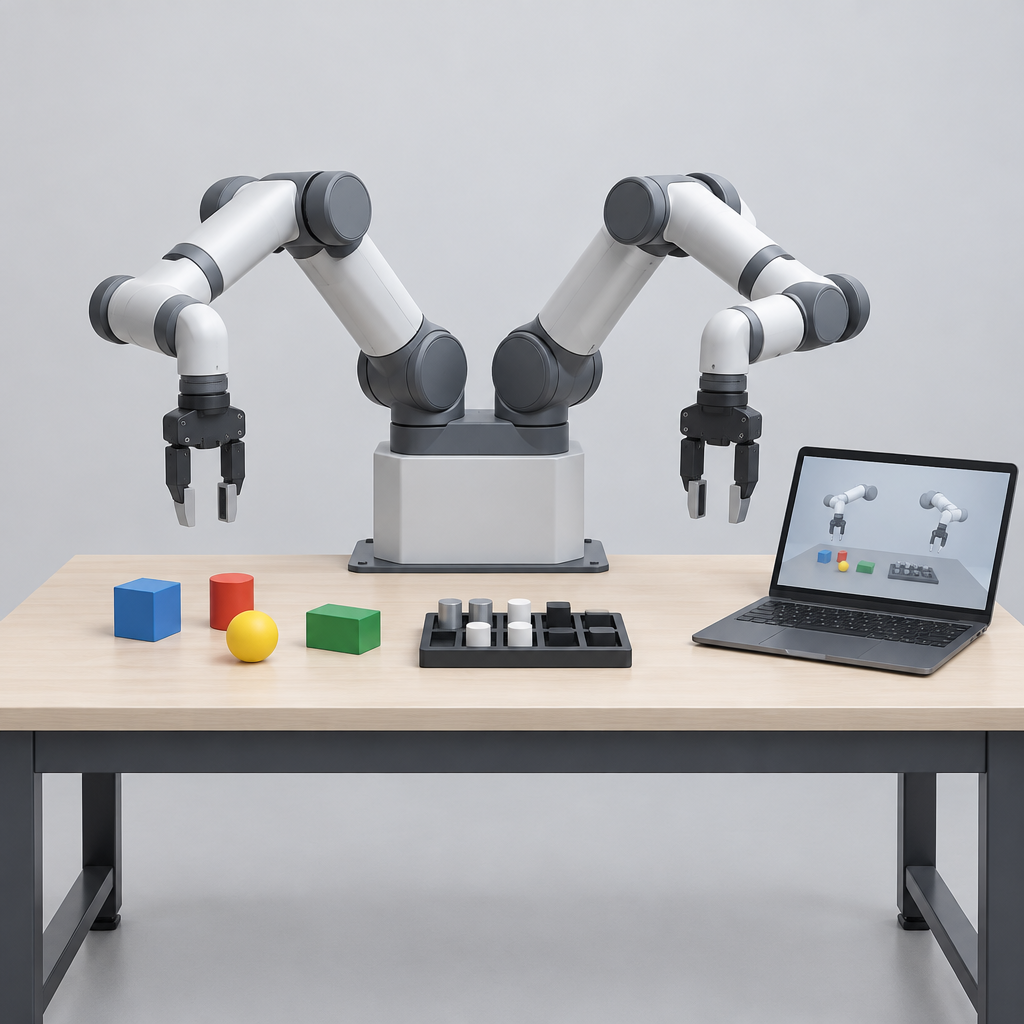
Dream Labs describes the initial zero-shot target as bimanual robots with parallel grippers. For unfamiliar embodiments, the model can predict gripper poses that the robot’s inverse-kinematics solver converts into joint commands. The company says performance depends on that solver, that it does not specify the arm’s complete path to a pose, and that some predicted states can be infeasible. It labels Dream-1 a research beta, unvalidated for safety-critical use. [1]
For a pilot, write down your actual arm configuration and gripper type, then ask which documented integration applies. A demonstration on another machine is a starting point for investigation. Before committing to a project, identify who owns the controller integration and how you will evaluate motion in the intended workspace.
Choose a control loop before choosing an install command
The official Python repository distinguishes two routes. dreamcli supplies a control loop with robot setup and Live View; dream.DreamClient lets developers send observations and receive actions from their own loop. Both require an API key from the platform. The repository’s Apache-2.0 license covers the library, with separately licensed vendored components and assets. That library license alone does not establish rights to the hosted model’s weights. [2]
The current PyPI listing identifies dreamlabs 1.0.18 as released October 23. Its declared Python requirement is at least 3.11 and below 3.14; its classifiers list Linux and Alpha development status. Match these requirements to your intended environment and record the exact client version used for your experiment. [3]
Before installing either route, obtain the current setup instructions for your account and robot. Keep the first experiment small enough to inspect its observations, returned actions and intervention log. No package installation or robot test was performed for this article.
Turn the hourly headline into an experiment budget
Dream Labs lists Dream-1 at $3 per hour and Dream-1-flash at $2. Its explanation equates one hour to 2,250 calls, each returning 1.6 seconds of actions. These are model-inference figures. [1]
For an illustrative ten hours at those published rates, inference would be $30 or $20. This arithmetic is not a quote for ten hours of successful work. Confirm current billing terms and record calls and charges during a small trial before extrapolating.
A more useful pilot ledger separates inference, hardware, integration time and human intervention. Suppose you aim to sort objects into bins: define a completed sort, count every attempt, and record resets and operator minutes. Divide the measured total cost by accepted completions. That creates a cost-per-result estimate for your own task; an hourly model price alone cannot supply it.
Read the benchmark as a specific evaluation
Robocurve’s current RoboDojo-RC Tier 1 table reports a 59.3% mean score for Dream-1 and estimated hosted inference of $0.15 per attempt, over 120 attempts per configuration. The page distinguishes mean score from elapsed time and states different attempt caps for LLMs and vision-language-action models. A mean benchmark score is not your robot’s task-completion probability. [4]
Use an external evaluation to choose what to investigate, then test the workflow you actually need. Specify an acceptance threshold before collecting results, preserve failed attempts alongside successes, and compare the pilot with your current process. Proceed when the measured benefit meets your threshold and the integration is understood; revise the task or stop when it does not.
Dream-1 pilot planning check
Sources
- [1] Dream Labs, Dream-1 research announcement and limitations, October 2026: https://dreamlabs.ai/research/dream-1/
- [2] Dream Labs official Python library and client routes: https://github.com/dreamlabs-co/dreamlabs
- [3] PyPI, dreamlabs release metadata and requirements: https://pypi.org/project/dreamlabs/
- [4] Robocurve, current robotics evaluation tables and release dates: https://robocurve.org/